Tuesday, December 15, 2009

Thursday, December 3, 2009
Climategate: Science Is Dying Science is on the credibility bubble.
Climategate: Science Is Dying
Science is on the credibility bubble.
By DANIEL HENNINGER
Surely there must have been serious men and women in the hard sciences who at some point worried that their colleagues in the global warming movement were putting at risk the credibility of everyone in science. The nature of that risk has been twofold: First, that the claims of the climate scientists might buckle beneath the weight of their breathtaking complexity. Second, that the crudeness of modern politics, once in motion, would trample the traditions and culture of science to achieve its own policy goals. With the scandal at the East Anglia Climate Research Unit, both have happened at once.
I don't think most scientists appreciate what has hit them. This isn't only about the credibility of global warming. For years, global warming and its advocates have been the public face of hard science. Most people could not name three other subjects they would associate with the work of serious scientists. This was it. The public was told repeatedly that something called "the scientific community" had affirmed the science beneath this inquiry. A Nobel Prize was bestowed (on a politician).
Global warming enlisted the collective reputation of science. Because "science" said so, all the world was about to undertake a vast reordering of human behavior at almost unimaginable financial cost. Not every day does the work of scientists lead to galactic events simply called Kyoto or Copenhagen. At least not since the Manhattan Project.
What is happening at East Anglia is an epochal event. As the hard sciences—physics, biology, chemistry, electrical engineering—came to dominate intellectual life in the last century, some academics in the humanities devised the theory of postmodernism, which liberated them from their colleagues in the sciences. Postmodernism, a self-consciously "unprovable" theory, replaced formal structures with subjectivity. With the revelations of East Anglia, this slippery and variable intellectual world has crossed into the hard sciences.
The Climate Emails
This has harsh implications for the credibility of science generally. Hard science, alongside medicine, was one of the few things left accorded automatic stature and respect by most untrained lay persons. But the average person reading accounts of the East Anglia emails will conclude that hard science has become just another faction, as politicized and "messy" as, say, gender studies. The New England Journal of Medicine has turned into a weird weekly amalgam of straight medical-research and propaganda for the Obama redesign of U.S. medicine.
The East Anglians' mistreatment of scientists who challenged global warming's claims—plotting to shut them up and shut down their ability to publish—evokes the attempt to silence Galileo. The exchanges between Penn State's Michael Mann and East Anglia CRU director Phil Jones sound like Father Firenzuola, the Commissary-General of the Inquisition.
For three centuries Galileo has symbolized dissent in science. In our time, most scientists outside this circle have kept silent as their climatologist fellows, helped by the cardinals of the press, mocked and ostracized scientists who questioned this grand theory of global doom. Even a doubter as eminent as Princeton's Freeman Dyson was dismissed as an aging crank.
Beneath this dispute is a relatively new, very postmodern environmental idea known as "the precautionary principle." As defined by one official version: "When an activity raises threats of harm to the environment or human health, precautionary measures should be taken even if some cause and effect relationships are not fully established scientifically." The global-warming establishment says we know "enough" to impose new rules on the world's use of carbon fuels. The dissenters say this demotes science's traditional standards of evidence.
What would Galileo do?
The Environmental Protection Agency's dramatic Endangerment Finding in April that greenhouse gas emissions qualify as an air pollutant—with implications for a vast new regulatory regime—used what the agency called a precautionary approach. The EPA admitted "varying degrees of uncertainty across many of these scientific issues." Again, this puts hard science in the new position of saying, close enough is good enough. One hopes civil engineers never build bridges under this theory.
The Obama administration's new head of policy at EPA, Lisa Heinzerling, is an advocate of turning precaution into standard policy. In a law-review article titled "Law and Economics for a Warming World," Ms. Heinzerling wrote, "Policy formation based on prediction and calculation of expected harm is no longer relevant; the only coherent response to a situation of chaotically worsening outcomes is a precautionary policy. . . ."
If the new ethos is that "close-enough" science is now sufficient to achieve political goals, serious scientists should be under no illusion that politicians will press-gang them into service for future agendas. Everyone working in science, no matter their politics, has an stake in cleaning up the mess revealed by the East Anglia emails. Science is on the credibility bubble. If it pops, centuries of what we understand to be the role of science go with it.
Write to henninger@wsj.com
Science is on the credibility bubble.
By DANIEL HENNINGER
Surely there must have been serious men and women in the hard sciences who at some point worried that their colleagues in the global warming movement were putting at risk the credibility of everyone in science. The nature of that risk has been twofold: First, that the claims of the climate scientists might buckle beneath the weight of their breathtaking complexity. Second, that the crudeness of modern politics, once in motion, would trample the traditions and culture of science to achieve its own policy goals. With the scandal at the East Anglia Climate Research Unit, both have happened at once.
I don't think most scientists appreciate what has hit them. This isn't only about the credibility of global warming. For years, global warming and its advocates have been the public face of hard science. Most people could not name three other subjects they would associate with the work of serious scientists. This was it. The public was told repeatedly that something called "the scientific community" had affirmed the science beneath this inquiry. A Nobel Prize was bestowed (on a politician).
Global warming enlisted the collective reputation of science. Because "science" said so, all the world was about to undertake a vast reordering of human behavior at almost unimaginable financial cost. Not every day does the work of scientists lead to galactic events simply called Kyoto or Copenhagen. At least not since the Manhattan Project.
What is happening at East Anglia is an epochal event. As the hard sciences—physics, biology, chemistry, electrical engineering—came to dominate intellectual life in the last century, some academics in the humanities devised the theory of postmodernism, which liberated them from their colleagues in the sciences. Postmodernism, a self-consciously "unprovable" theory, replaced formal structures with subjectivity. With the revelations of East Anglia, this slippery and variable intellectual world has crossed into the hard sciences.
The Climate Emails
This has harsh implications for the credibility of science generally. Hard science, alongside medicine, was one of the few things left accorded automatic stature and respect by most untrained lay persons. But the average person reading accounts of the East Anglia emails will conclude that hard science has become just another faction, as politicized and "messy" as, say, gender studies. The New England Journal of Medicine has turned into a weird weekly amalgam of straight medical-research and propaganda for the Obama redesign of U.S. medicine.
The East Anglians' mistreatment of scientists who challenged global warming's claims—plotting to shut them up and shut down their ability to publish—evokes the attempt to silence Galileo. The exchanges between Penn State's Michael Mann and East Anglia CRU director Phil Jones sound like Father Firenzuola, the Commissary-General of the Inquisition.
For three centuries Galileo has symbolized dissent in science. In our time, most scientists outside this circle have kept silent as their climatologist fellows, helped by the cardinals of the press, mocked and ostracized scientists who questioned this grand theory of global doom. Even a doubter as eminent as Princeton's Freeman Dyson was dismissed as an aging crank.
Beneath this dispute is a relatively new, very postmodern environmental idea known as "the precautionary principle." As defined by one official version: "When an activity raises threats of harm to the environment or human health, precautionary measures should be taken even if some cause and effect relationships are not fully established scientifically." The global-warming establishment says we know "enough" to impose new rules on the world's use of carbon fuels. The dissenters say this demotes science's traditional standards of evidence.
What would Galileo do?
The Environmental Protection Agency's dramatic Endangerment Finding in April that greenhouse gas emissions qualify as an air pollutant—with implications for a vast new regulatory regime—used what the agency called a precautionary approach. The EPA admitted "varying degrees of uncertainty across many of these scientific issues." Again, this puts hard science in the new position of saying, close enough is good enough. One hopes civil engineers never build bridges under this theory.
The Obama administration's new head of policy at EPA, Lisa Heinzerling, is an advocate of turning precaution into standard policy. In a law-review article titled "Law and Economics for a Warming World," Ms. Heinzerling wrote, "Policy formation based on prediction and calculation of expected harm is no longer relevant; the only coherent response to a situation of chaotically worsening outcomes is a precautionary policy. . . ."
If the new ethos is that "close-enough" science is now sufficient to achieve political goals, serious scientists should be under no illusion that politicians will press-gang them into service for future agendas. Everyone working in science, no matter their politics, has an stake in cleaning up the mess revealed by the East Anglia emails. Science is on the credibility bubble. If it pops, centuries of what we understand to be the role of science go with it.
Write to henninger@wsj.com
Tuesday, December 1, 2009
Putting the important tasks first!
http://www.thesimpledollar.com/2009/11/30/putting-the-important-but-not-urgent-tasks-above-the-urgent-but-not-important-tasks/
Good short article about looking at projects in the big picture.
Monday, November 30, 2009
My blogs!
I got a writing gig at and my first article was posted today: http://www.myhousecallmd.com/
I am also working on a swimming blog that averages about 45 visits a day found here: http://swimscience.blogspot.com/
I hope no one tells these people I got a C+ in english 106 at Purdue, haha
I am also working on a swimming blog that averages about 45 visits a day found here: http://swimscience.blogspot.com/
I hope no one tells these people I got a C+ in english 106 at Purdue, haha
Wednesday, November 25, 2009
Football Players and Head Trauma
http://www.medpagetoday.com/Neurology/HeadTrauma/17156
I don't know what to think about all the concussions in football. One side, it is a contact sport and injuries do happen, they are grown men and can make their own decisions. However, being pressured to put your life at risk and potentially obtaining Parkinson's like symptoms at the age of 50...maybe stricter regulations should be mandated.
Tuesday, November 24, 2009
Interesting radical view on thanksgiving
I heard this on the radio last night. I may use some of the arguments in upcoming debate rounds :)
http://www.airp.uci.edu/blog/2009/11/1123-aia-reciprocity-by-confounding.html
http://www.airp.uci.edu/blog/2009/11/1123-aia-reciprocity-by-confounding.html
New Mammogram Guidelines
http://democrats.senate.gov/reform/patient-protection-affordable-care-act.pdf
New guidelines suggest holding off mammograms women are 50 years of age (pg. 17). Cost efficient or cruel?
Good skin Bacteria?
http://www.sciencedaily.com/releases/2009/11/091122161742.htm
A nice article about exposure to certain bacteria is essential for healthy protection from pathogens and prevention of inflammation.
Monday, November 23, 2009
Technology is stranger than Fiction
Best-selling writer Cory Doctorow on change and its discontents.
When Mary Shelley wrote "Frankenstein" in the early 1800s, the issue was not corpses brought back to life. The novel captured anxiety about then-emerging technologies such as the steam engine, as people began to ask whether we know what we're doing with what we invent. We've been asking ever since, with science fiction a handy way to track our comfort level with technology.
By this measure, we're still anxious but getting more optimistic that we'll be able to cope even with today's accelerated pace of change.
Consider the world of "Makers," the latest by best-selling writer Cory Doctorow. This novel is set in a not-too distant future, when the creative destruction of technological change has created an economy so efficient, with profit margins so thin, that traditional companies can hardly stay in business.
The inventor-heroes of "Makers" take technology to its conclusion: They figure out a way to use three-dimensional printers to produce copies of machines and most anything else at close to no cost. This sparks "New Work," with geeky investment bankers scouring the country to fund promising artisans who use the technology to build things cheaply. The heroes also run a series of entertainment rides across the country in abandoned Wal-Marts, until Disney unleashes its lawyers on them.
Mr. Doctorow, a Canadian living in London, has a keen eye for the pressures on contemporary business. In the novel, an M.B.A. brought in to work with the inventors explains, "The system makes it hard to sell anything above the marginal cost of goods, unless you have a really innovative idea, which can't stay innovative for long, so you need continuous invention and reinvention, too."
This theme captures current anxieties. Technology lets low-cost providers take market share away from established companies, as Detroit auto makers and Paris fashion house designers have seen. Even high-tech companies have a hard time building sustainable businesses now that good ideas are copied so quickly that they become commodities.
"Every industry that required a factory yesterday only needs a garage today," the fictional business manager explains. "Here's what I think the point of a good market is. In a good market, you invent something and you charge all the market will bear for it." Then someone figures out a way to do it more cheaply or accepts a lower profit margin, "until eventually you get down to a kind of firmament, a baseline that you can't go lower than, the cheapest you can produce a product and stay in business. That's why straight pins, machine screws, and a ream of paper all cost basically nothing, and make damned little profit for their manufacturers."
In the world of "Makers," and perhaps in our own world, "we're approaching a kind of pure and perfect state now, with competition and invention getting easier and easier—it's producing a kind of superabundance."
Mr. Doctorow paints a bleak picture of the process of getting there, even if many of us take a more benign view of increasingly efficient capitalism. "Makers" features widespread unemployment, with 20% of workers relocating to look for jobs. Even with scientific advances—obesity is solved, for example—life is brutal. There are squatter neighborhoods alongside abandoned strip malls.
Mr. Doctorow's science fiction also includes the too-true prospect of venture capital firms deciding that the next big thing in technology is financing litigation over copyright and other intellectual property. There are also amusing comments on business. One character describes trying to make change at large companies as being "like turning around a battleship by tapping it on the nose with a toothpick."
Mr. Doctorow practices what he preaches about new economics. He was the first, in 2003, to publish a novel released at the same time under a Creative Commons license in a free e-reader edition. "Makers" sells in hardback, but chapters are available for free downloads—a reminder that the convenience of the printed book is worth the $24.99 purchase price to some readers.
He plans to sell his next book, a collection of short stories, in various price ranges, which he thinks will maximize his revenues. There will be a free download or audiobook, an inexpensive paperback, a pricier hardback, plus one book for $10,000 that lets the buyer commission a short story.
In an online essay for the literary magazine Tin House, Mr. Doctorow wrote that "science fiction writers don't predict the future (except accidentally), but if they're very good, they may manage to predict the present."
In a time of great change, fiction can sometimes provide better understanding than facts alone. "As the pace of technological change accelerates, the job of the science fiction writer becomes not harder, but easier—and more necessary," he writes. "After all, the more confused we are by our contemporary technology, the more opportunities there are to tell stories that lessen that confusion."
When Mary Shelley wrote "Frankenstein" in the early 1800s, the issue was not corpses brought back to life. The novel captured anxiety about then-emerging technologies such as the steam engine, as people began to ask whether we know what we're doing with what we invent. We've been asking ever since, with science fiction a handy way to track our comfort level with technology.
By this measure, we're still anxious but getting more optimistic that we'll be able to cope even with today's accelerated pace of change.
Consider the world of "Makers," the latest by best-selling writer Cory Doctorow. This novel is set in a not-too distant future, when the creative destruction of technological change has created an economy so efficient, with profit margins so thin, that traditional companies can hardly stay in business.
The inventor-heroes of "Makers" take technology to its conclusion: They figure out a way to use three-dimensional printers to produce copies of machines and most anything else at close to no cost. This sparks "New Work," with geeky investment bankers scouring the country to fund promising artisans who use the technology to build things cheaply. The heroes also run a series of entertainment rides across the country in abandoned Wal-Marts, until Disney unleashes its lawyers on them.
Mr. Doctorow, a Canadian living in London, has a keen eye for the pressures on contemporary business. In the novel, an M.B.A. brought in to work with the inventors explains, "The system makes it hard to sell anything above the marginal cost of goods, unless you have a really innovative idea, which can't stay innovative for long, so you need continuous invention and reinvention, too."
This theme captures current anxieties. Technology lets low-cost providers take market share away from established companies, as Detroit auto makers and Paris fashion house designers have seen. Even high-tech companies have a hard time building sustainable businesses now that good ideas are copied so quickly that they become commodities.
"Every industry that required a factory yesterday only needs a garage today," the fictional business manager explains. "Here's what I think the point of a good market is. In a good market, you invent something and you charge all the market will bear for it." Then someone figures out a way to do it more cheaply or accepts a lower profit margin, "until eventually you get down to a kind of firmament, a baseline that you can't go lower than, the cheapest you can produce a product and stay in business. That's why straight pins, machine screws, and a ream of paper all cost basically nothing, and make damned little profit for their manufacturers."
In the world of "Makers," and perhaps in our own world, "we're approaching a kind of pure and perfect state now, with competition and invention getting easier and easier—it's producing a kind of superabundance."
Mr. Doctorow paints a bleak picture of the process of getting there, even if many of us take a more benign view of increasingly efficient capitalism. "Makers" features widespread unemployment, with 20% of workers relocating to look for jobs. Even with scientific advances—obesity is solved, for example—life is brutal. There are squatter neighborhoods alongside abandoned strip malls.
Mr. Doctorow's science fiction also includes the too-true prospect of venture capital firms deciding that the next big thing in technology is financing litigation over copyright and other intellectual property. There are also amusing comments on business. One character describes trying to make change at large companies as being "like turning around a battleship by tapping it on the nose with a toothpick."
Mr. Doctorow practices what he preaches about new economics. He was the first, in 2003, to publish a novel released at the same time under a Creative Commons license in a free e-reader edition. "Makers" sells in hardback, but chapters are available for free downloads—a reminder that the convenience of the printed book is worth the $24.99 purchase price to some readers.
He plans to sell his next book, a collection of short stories, in various price ranges, which he thinks will maximize his revenues. There will be a free download or audiobook, an inexpensive paperback, a pricier hardback, plus one book for $10,000 that lets the buyer commission a short story.
In an online essay for the literary magazine Tin House, Mr. Doctorow wrote that "science fiction writers don't predict the future (except accidentally), but if they're very good, they may manage to predict the present."
In a time of great change, fiction can sometimes provide better understanding than facts alone. "As the pace of technological change accelerates, the job of the science fiction writer becomes not harder, but easier—and more necessary," he writes. "After all, the more confused we are by our contemporary technology, the more opportunities there are to tell stories that lessen that confusion."
Bing Eating a Psychiatric Disorder?
http://www.latimes.com/features/health/la-he-binge23-2009nov23,0,2869829.story
There appears to be debate surrounding binge eating and the mentality behind this disorder. I do think it is a psychiatric disorder, because these people not only consume huge amounts of foods, but they act similarly to drug addicts by lying about the food they eat and only eating when no one is around. Other than the mass consumption, these people also think about food constantly, diminishing their productivity. Negatively if this pathology is sanctioned, it will increase the medication umbrella on health care and society.
What do you think?
Tuesday, October 20, 2009
Thursday, October 8, 2009
Pick 5 us cities you would move to before you read this article
The Next Youth-Magnet Cities
By SUE SHELLENBARGER
-->
If you were a recent college graduate in a recovering economy launching a career, looking for a mate or both, where would you choose to live?
Predicting cities that will emerge as post-recession meccas for the young is easy to argue about, but impossible to forecast empirically. Whether you prefer hip, casual Austin, Texas, over the cosmopolitan allure of New York City is partly a matter of personal taste. Still, we asked six experts which 10 cities will emerge as the hottest, hippest destinations for highly mobile, educated workers in their 20s when the U.S. economy gets moving again. Our panelists—demographers, economists, geographers and authors on urban issues—picked their cities based on the criteria they deem most important, from economic diversity to lifestyle.
Big cities dominate our panelists' forecasts. Where trendy smaller cities might have captivated youth in the past, today's recession-scarred young people are more pragmatic, placing "greater emphasis on where high-quality, high-paying jobs are created," says Ross DeVol, director of regional economics for the nonprofit Milken Institute. Northeastern and West Coast cities are ascendant, eclipsing former Sunbelt favorites such as Atlanta.
Other cities once lauded as youth magnets fell off the radar. Naples, Fla., cited in an influential 2003 U.S. Census Bureau report on migration among young adults, was bypassed by panelists, a victim of the sagging Florida economy. The housing collapse sank another past favorite, former real-estate boom town Las Vegas. And Charlotte, N.C., a banking center, lost some of its luster to the financial crisis.
Quirky urban cultures haven't entirely lost their allure. Our panelists' No. 4 pick is a city with double-digit unemployment—Portland, Ore., a haven for artists, musicians and outdoor enthusiasts. The city has shown "staying power" among youth, says Rachel Franklin, a geographer at the University of Maryland and author of the Census Bureau report.
Where young adults settle is no small thing. People 18 to 29 are the most mobile age group, and their past migration patterns have defined the future of regions, from the long rural exodus of the 1900s to the Silicon Valley boom of the 1990s. Youth-magnet cities gain an enviable cultural allure and a labor-market edge.
The young are likely to be more restless than usual when the recovery comes. The recession has brought migration to a grinding halt: Fewer people moved across state lines in 2008 than at any time since 1950, when the population was smaller by half, says William Frey, a senior fellow at the Brookings Institution, a nonprofit Washington research organization.
Here's a look at our survey's top five cities:
First Place (Tie): Washington, D.C.
The 2008 election touched off a youthful pilgrimage to the capital that most panelists say won't end soon. "In the eyes of some young people, Barack Obama is America's coolest boss," says Richard Florida, author of "Who's Your City?" and a professor of business and creativity at the University of Toronto's Rotman School of Management.
Government hiring is projected to grow fast, and jobs in lobbying, aerospace, defense contracting and professional services are also a draw. Mr. DeVol calls Washington the national leader in high-tech services, surpassing Silicon Valley. Washington's 4,000-plus nonprofits hold appeal for service-minded youth. And amid rising regulation of financial markets, says Barbara Lang, president of the DC Chamber of Commerce, "much of Wall Street is now moving to K Street."
David Gibson Jr., 25 years old, passed up finance jobs in Charlotte, New York and Atlanta to settle in Washington as a financial analyst for the Federal Reserve. Mr. Gibson, who has an M.B.A., figures the capital, with its many universities, can accommodate him for the long haul, enabling him to pursue a Ph.D. if he chooses. He loves the city's museums and live jazz and R&B venues, he says, and its power-center status is helping him "expand my network world-wide."
That combination of factors, says David Plane, a professor of geography and regional development at the University of Arizona, signals "sustained dynamism" for Washington.
The downside: Not all see the current federal hiring binge continuing. "Right now Washington is a magnet. It has become the new New York," says Steven Cochrane, managing director of Moody's Economy.com. But the ballooning federal deficit suggests that "by next year, the government is going to be looking seriously at making cuts."
First Place (Tie): Seattle
Former Ohio residents Lane Kuhlman, 26, and her husband, Matt Mansbach, 32, mulled several cities, including New York and Chicago, as potential destinations last summer, after Ms. Kuhlman received her master's degree specializing in interactive media.
In their eyes, none could match Seattle's combination of a diverse high-tech sector, cultural life, access to rugged natural terrain and a strong university presence. Ms. Kuhlman has since taken a post as a new-product researcher for Microsoft, and Mr. Mansbach is weighing attending one of the city's grad schools in his field, computer animation. Meanwhile, Ms. Kuhlman says, "we're only 15 minutes from a beautiful waterfall, and there are amazing places to hike."
Anchor to a region of corporate innovators, from Amazon.com to Starbucks, Seattle is "a high-tech and lifestyle mecca," Dr. Florida says. Mr. DeVol says the city's high-tech sector, with 226,300 workers, is just slightly smaller than Silicon Valley's. Joblessness, at 7.7%, remains relatively low. City officials see rapid growth in biotech; Seattle also has tens of thousands of jobs in music and interactive media. And it enjoys a reputation as home to a lot of brainy people.
The downside: It rains half the time.
Work & Family Mailbox
Sue Shellenbarger answers readers' questions.
How We Selected Our Top-Rated Cities
Naming the next wave of top cities for hip, highly mobile young adults is far from an exact science. It's more like a parlor game.
The Wall Street Journal sought out six of the nation's leading experts to rank the 10 U.S. cities they see as most likely to emerge as "youth magnet" cities after the recession—popular target destinations among young, college-educated, often single people setting out to start a career, find a mate or both.
The panelists, who were also asked to provide two or three reasons for their selections, were chosen based on their achievements in research, forecasting or authorship in the fields of geography, regional economics or demography.
The methodology used to compile a final list is closer to a straw poll than a scientific study.
Using criteria of their own choosing, experts provided ranked lists of picks. Composite rankings were then assigned to cities based on a point system: Each expert's No. 1 pick was given 10 points, second choices were given nine points and so on, with 10th-place picks receiving one point. Final rankings were determined by adding the total points each city received.
The panelists:
Steven Cochrane , managing director, Moody's Economy.com, head of the Web site's U.S. regional forecasting service and editor of its monthly Regional Financial Review.
Ross DeVol , director of regional economics, the Milken Institute, a Santa Monica, Calif., nonprofit, and researcher on technology and its impact on regional and national economies.
Richard Florida , author of "Who's Your City" and "The Rise of the Creative Class," and director of the Martin Prosperity Institute at the University of Toronto's Rotman School of Management.
Rachel Franklin , senior lecturer, public policy, at the University of Maryland; former deputy director of the Association of American Geographers, and author of a 2003 Census Bureau report on migration patterns among young, educated workers.
William Frey , demographer and senior fellow at the Metropolitan Policy Program of the Brookings Institution, Washington, D.C., and a research professor in population studies at the University of Michigan.
David Plane , professor of geography and regional development, University of Arizona, Tucson; a senior editor of the Journal of Regional Science, and researcher on age-related factors in migration.
Third Place: New York
Reeling from the financial crisis, the nation's largest city may seem an unlikely pick. But one reason New York's unemployment rate is stuck at a daunting 10.3% is that hopeful job seekers continue to move there, city officials say. Clearly, "the city's mythic status as a place to test one's mettle against the best and the brightest" remains intact, Dr. Florida says.
New York hasn't lost as many financial-services jobs as predicted, says Deputy Mayor Robert Lieber; so far, fewer than half of the 293,000 job losses that were projected by the city from 2009 through mid-2010 have materialized. Residential growth in boroughs outside Manhattan, such as Brooklyn, is making the city marginally more affordable, and some panelists see housing prices falling more.
At Vermont's Middlebury College, New York surpasses nearby Boston as the destination of choice for the class of 2010, says Jaye Roseborough, career-services director. Allison Bailey, a 2009 grad, loves the city's "European lifestyle," she says. After studying in France, "I wanted to be in a 'walking city' like Paris." Working lots of overtime as a litigation assistant for a law firm, she can manage the $1,450 monthly rent for her Manhattan studio, she says. And she is happy to leave behind the long car commutes of her native Houston.
The downside: The city is still unaffordable for many, and the less-pricey suburbs can impose enervating commutes.
Fourth Place: Portland, Ore.
Los Angeles native Ryan O'Leary, 23, didn't expect when he graduated from college with a journalism degree last year to be working construction at this point, he says. But he decided about a month ago to give top priority to moving to the place he most wanted to live, and Portland was it—despite its daunting 11.2% unemployment rate.
Mr. O'Leary, who found an apartment downtown, calls his move "the best decision I've made in a long time." He loves the city's nightlife and neighborhoods, and the city's streetcars—one of which stops by his building—are a refreshing change from Los Angeles's car culture. He continues to job-hunt in his field, public relations, on his days off.
A symbol of "West Coast hipness," Ms. Franklin says, Portland has continued to draw migrants through the recession. An urban-growth boundary fosters a strong downtown culture while containing suburban sprawl, easing travel to nearby mountains and forests. Portland has expanded mass transit and boasts sizeable electronics and activewear companies, several wind- and solar-energy firms, and many green-building projects.
Its quirky culture appeals to musicians and artists: The city has more than its share of oddball events, including an adult soap-box derby and an urban Iditarod (wherein costumed revelers pull shopping carts). "Keep Portland Weird" is a popular bumper sticker. Although Austin claimed that motto first in the 1980s, "we live it pretty well here," says a city staffer.
The downside: While regional officials have laid plans to add 10,000 jobs in the next five years, Portland has done better at promoting its quality of life than fostering job growth. "As nice as it may be to live in Portland," says Economy.com's Dr. Cochrane, "you can only sleep on someone's couch for so long. At some point you have to get a job."
Fifth Place: Austin, Texas
After a year spent traveling and working overseas in 2007, New Jersey resident Olga Garcia, 26, and her boyfriend, Kevin Kurkjian, 27, debated places to settle. Then Kevin announced, "Olga, I've got it figured out: We're going to Austin." She agreed. Both had heard from friends that Austin offered housing and career opportunities and a welcoming, youthful culture. "I had never heard anything bad about Austin," says Ms. Garcia, a marketing consultant.
A state capital and the site of a big University of Texas campus, Austin has become a gathering place for tech- and arts-conscious young adults. Its SXSW media and arts conference, and its Austin City Limits music festival, draw hundreds of thousands of visitors each year. Both unemployment and the cost of living are relatively low. And with significant high-tech, videogame and renewable-energy sectors, Mr. DeVol calls Austin "a model for a thriving 21st-century knowledge-based community."
The downside: Some panelists have doubts about how strongly Austin will rebound after the recession.
By SUE SHELLENBARGER
-->
If you were a recent college graduate in a recovering economy launching a career, looking for a mate or both, where would you choose to live?
Predicting cities that will emerge as post-recession meccas for the young is easy to argue about, but impossible to forecast empirically. Whether you prefer hip, casual Austin, Texas, over the cosmopolitan allure of New York City is partly a matter of personal taste. Still, we asked six experts which 10 cities will emerge as the hottest, hippest destinations for highly mobile, educated workers in their 20s when the U.S. economy gets moving again. Our panelists—demographers, economists, geographers and authors on urban issues—picked their cities based on the criteria they deem most important, from economic diversity to lifestyle.
Big cities dominate our panelists' forecasts. Where trendy smaller cities might have captivated youth in the past, today's recession-scarred young people are more pragmatic, placing "greater emphasis on where high-quality, high-paying jobs are created," says Ross DeVol, director of regional economics for the nonprofit Milken Institute. Northeastern and West Coast cities are ascendant, eclipsing former Sunbelt favorites such as Atlanta.
Other cities once lauded as youth magnets fell off the radar. Naples, Fla., cited in an influential 2003 U.S. Census Bureau report on migration among young adults, was bypassed by panelists, a victim of the sagging Florida economy. The housing collapse sank another past favorite, former real-estate boom town Las Vegas. And Charlotte, N.C., a banking center, lost some of its luster to the financial crisis.
Quirky urban cultures haven't entirely lost their allure. Our panelists' No. 4 pick is a city with double-digit unemployment—Portland, Ore., a haven for artists, musicians and outdoor enthusiasts. The city has shown "staying power" among youth, says Rachel Franklin, a geographer at the University of Maryland and author of the Census Bureau report.
Where young adults settle is no small thing. People 18 to 29 are the most mobile age group, and their past migration patterns have defined the future of regions, from the long rural exodus of the 1900s to the Silicon Valley boom of the 1990s. Youth-magnet cities gain an enviable cultural allure and a labor-market edge.
The young are likely to be more restless than usual when the recovery comes. The recession has brought migration to a grinding halt: Fewer people moved across state lines in 2008 than at any time since 1950, when the population was smaller by half, says William Frey, a senior fellow at the Brookings Institution, a nonprofit Washington research organization.
Here's a look at our survey's top five cities:
First Place (Tie): Washington, D.C.
The 2008 election touched off a youthful pilgrimage to the capital that most panelists say won't end soon. "In the eyes of some young people, Barack Obama is America's coolest boss," says Richard Florida, author of "Who's Your City?" and a professor of business and creativity at the University of Toronto's Rotman School of Management.
Government hiring is projected to grow fast, and jobs in lobbying, aerospace, defense contracting and professional services are also a draw. Mr. DeVol calls Washington the national leader in high-tech services, surpassing Silicon Valley. Washington's 4,000-plus nonprofits hold appeal for service-minded youth. And amid rising regulation of financial markets, says Barbara Lang, president of the DC Chamber of Commerce, "much of Wall Street is now moving to K Street."
David Gibson Jr., 25 years old, passed up finance jobs in Charlotte, New York and Atlanta to settle in Washington as a financial analyst for the Federal Reserve. Mr. Gibson, who has an M.B.A., figures the capital, with its many universities, can accommodate him for the long haul, enabling him to pursue a Ph.D. if he chooses. He loves the city's museums and live jazz and R&B venues, he says, and its power-center status is helping him "expand my network world-wide."
That combination of factors, says David Plane, a professor of geography and regional development at the University of Arizona, signals "sustained dynamism" for Washington.
The downside: Not all see the current federal hiring binge continuing. "Right now Washington is a magnet. It has become the new New York," says Steven Cochrane, managing director of Moody's Economy.com. But the ballooning federal deficit suggests that "by next year, the government is going to be looking seriously at making cuts."
First Place (Tie): Seattle
Former Ohio residents Lane Kuhlman, 26, and her husband, Matt Mansbach, 32, mulled several cities, including New York and Chicago, as potential destinations last summer, after Ms. Kuhlman received her master's degree specializing in interactive media.
In their eyes, none could match Seattle's combination of a diverse high-tech sector, cultural life, access to rugged natural terrain and a strong university presence. Ms. Kuhlman has since taken a post as a new-product researcher for Microsoft, and Mr. Mansbach is weighing attending one of the city's grad schools in his field, computer animation. Meanwhile, Ms. Kuhlman says, "we're only 15 minutes from a beautiful waterfall, and there are amazing places to hike."
Anchor to a region of corporate innovators, from Amazon.com to Starbucks, Seattle is "a high-tech and lifestyle mecca," Dr. Florida says. Mr. DeVol says the city's high-tech sector, with 226,300 workers, is just slightly smaller than Silicon Valley's. Joblessness, at 7.7%, remains relatively low. City officials see rapid growth in biotech; Seattle also has tens of thousands of jobs in music and interactive media. And it enjoys a reputation as home to a lot of brainy people.
The downside: It rains half the time.
Work & Family Mailbox
Sue Shellenbarger answers readers' questions.
How We Selected Our Top-Rated Cities
Naming the next wave of top cities for hip, highly mobile young adults is far from an exact science. It's more like a parlor game.
The Wall Street Journal sought out six of the nation's leading experts to rank the 10 U.S. cities they see as most likely to emerge as "youth magnet" cities after the recession—popular target destinations among young, college-educated, often single people setting out to start a career, find a mate or both.
The panelists, who were also asked to provide two or three reasons for their selections, were chosen based on their achievements in research, forecasting or authorship in the fields of geography, regional economics or demography.
The methodology used to compile a final list is closer to a straw poll than a scientific study.
Using criteria of their own choosing, experts provided ranked lists of picks. Composite rankings were then assigned to cities based on a point system: Each expert's No. 1 pick was given 10 points, second choices were given nine points and so on, with 10th-place picks receiving one point. Final rankings were determined by adding the total points each city received.
The panelists:
Steven Cochrane , managing director, Moody's Economy.com, head of the Web site's U.S. regional forecasting service and editor of its monthly Regional Financial Review.
Ross DeVol , director of regional economics, the Milken Institute, a Santa Monica, Calif., nonprofit, and researcher on technology and its impact on regional and national economies.
Richard Florida , author of "Who's Your City" and "The Rise of the Creative Class," and director of the Martin Prosperity Institute at the University of Toronto's Rotman School of Management.
Rachel Franklin , senior lecturer, public policy, at the University of Maryland; former deputy director of the Association of American Geographers, and author of a 2003 Census Bureau report on migration patterns among young, educated workers.
William Frey , demographer and senior fellow at the Metropolitan Policy Program of the Brookings Institution, Washington, D.C., and a research professor in population studies at the University of Michigan.
David Plane , professor of geography and regional development, University of Arizona, Tucson; a senior editor of the Journal of Regional Science, and researcher on age-related factors in migration.
Third Place: New York
Reeling from the financial crisis, the nation's largest city may seem an unlikely pick. But one reason New York's unemployment rate is stuck at a daunting 10.3% is that hopeful job seekers continue to move there, city officials say. Clearly, "the city's mythic status as a place to test one's mettle against the best and the brightest" remains intact, Dr. Florida says.
New York hasn't lost as many financial-services jobs as predicted, says Deputy Mayor Robert Lieber; so far, fewer than half of the 293,000 job losses that were projected by the city from 2009 through mid-2010 have materialized. Residential growth in boroughs outside Manhattan, such as Brooklyn, is making the city marginally more affordable, and some panelists see housing prices falling more.
At Vermont's Middlebury College, New York surpasses nearby Boston as the destination of choice for the class of 2010, says Jaye Roseborough, career-services director. Allison Bailey, a 2009 grad, loves the city's "European lifestyle," she says. After studying in France, "I wanted to be in a 'walking city' like Paris." Working lots of overtime as a litigation assistant for a law firm, she can manage the $1,450 monthly rent for her Manhattan studio, she says. And she is happy to leave behind the long car commutes of her native Houston.
The downside: The city is still unaffordable for many, and the less-pricey suburbs can impose enervating commutes.
Fourth Place: Portland, Ore.
Los Angeles native Ryan O'Leary, 23, didn't expect when he graduated from college with a journalism degree last year to be working construction at this point, he says. But he decided about a month ago to give top priority to moving to the place he most wanted to live, and Portland was it—despite its daunting 11.2% unemployment rate.
Mr. O'Leary, who found an apartment downtown, calls his move "the best decision I've made in a long time." He loves the city's nightlife and neighborhoods, and the city's streetcars—one of which stops by his building—are a refreshing change from Los Angeles's car culture. He continues to job-hunt in his field, public relations, on his days off.
A symbol of "West Coast hipness," Ms. Franklin says, Portland has continued to draw migrants through the recession. An urban-growth boundary fosters a strong downtown culture while containing suburban sprawl, easing travel to nearby mountains and forests. Portland has expanded mass transit and boasts sizeable electronics and activewear companies, several wind- and solar-energy firms, and many green-building projects.
Its quirky culture appeals to musicians and artists: The city has more than its share of oddball events, including an adult soap-box derby and an urban Iditarod (wherein costumed revelers pull shopping carts). "Keep Portland Weird" is a popular bumper sticker. Although Austin claimed that motto first in the 1980s, "we live it pretty well here," says a city staffer.
The downside: While regional officials have laid plans to add 10,000 jobs in the next five years, Portland has done better at promoting its quality of life than fostering job growth. "As nice as it may be to live in Portland," says Economy.com's Dr. Cochrane, "you can only sleep on someone's couch for so long. At some point you have to get a job."
Fifth Place: Austin, Texas
After a year spent traveling and working overseas in 2007, New Jersey resident Olga Garcia, 26, and her boyfriend, Kevin Kurkjian, 27, debated places to settle. Then Kevin announced, "Olga, I've got it figured out: We're going to Austin." She agreed. Both had heard from friends that Austin offered housing and career opportunities and a welcoming, youthful culture. "I had never heard anything bad about Austin," says Ms. Garcia, a marketing consultant.
A state capital and the site of a big University of Texas campus, Austin has become a gathering place for tech- and arts-conscious young adults. Its SXSW media and arts conference, and its Austin City Limits music festival, draw hundreds of thousands of visitors each year. Both unemployment and the cost of living are relatively low. And with significant high-tech, videogame and renewable-energy sectors, Mr. DeVol calls Austin "a model for a thriving 21st-century knowledge-based community."
The downside: Some panelists have doubts about how strongly Austin will rebound after the recession.
Saturday, October 3, 2009
Professor: Smaller Class Sizes Optimal For Kids
This is a good story I heard on NPR. If we are serious about leveling the playing field and leaving "no child behind: we certainly could hire more teachers. Rising class sizes in elementary schools mean there are currently lots of unemployed elementary school teachers, many of whom were actively recruited not long ago.
http://www.npr.org/templates/story/story.php?storyId=113176988
http://www.npr.org/templates/story/story.php?storyId=113176988
Friday, October 2, 2009
Unintented consequences of Iraq
Neocon Iraq Policy Has Been Costly
Regarding Bret Stephens's "The Neocons Make a Comeback" (Global View, Sept. 29): Nothing says more about the failure of the neoconservative-inspired foreign policy of George W. Bush than our current standoff with Iran.
By crippling the Sunni-dominated Iraqi dictatorship as a regional power, rather than pursuing the more limited goals of containing its political and military influence, the U.S. removed the one tried and true counterbalance to the Shiite-fascist Iranian dictatorship. Iran has benefited greatly by our having forcefully removed, at considerable cost, a natural enemy, Sunni Baathist Iraq, with which it fought a costly eight-year war in the 1980s.
Now that it is generally accepted throughout the world that the U.S.-led invasion of Iraq was based on erroneous intelligence information, key potential allies in our efforts to challenge Iran, such as China, have an excuse to be skeptical about the application of "crippling sanctions." Ironically, Israel is now at greater risk than at any time in its 61-year history.
To make matters worse, the diversion of precious military resources to Iraq has enabled a Taliban comeback in Afghanistan and in the Pakistan frontier at a time when the American public has little appetite for escalating the battle.
Scott Bernstein
Muttontown, N.Y.
Regarding Bret Stephens's "The Neocons Make a Comeback" (Global View, Sept. 29): Nothing says more about the failure of the neoconservative-inspired foreign policy of George W. Bush than our current standoff with Iran.
By crippling the Sunni-dominated Iraqi dictatorship as a regional power, rather than pursuing the more limited goals of containing its political and military influence, the U.S. removed the one tried and true counterbalance to the Shiite-fascist Iranian dictatorship. Iran has benefited greatly by our having forcefully removed, at considerable cost, a natural enemy, Sunni Baathist Iraq, with which it fought a costly eight-year war in the 1980s.
Now that it is generally accepted throughout the world that the U.S.-led invasion of Iraq was based on erroneous intelligence information, key potential allies in our efforts to challenge Iran, such as China, have an excuse to be skeptical about the application of "crippling sanctions." Ironically, Israel is now at greater risk than at any time in its 61-year history.
To make matters worse, the diversion of precious military resources to Iraq has enabled a Taliban comeback in Afghanistan and in the Pakistan frontier at a time when the American public has little appetite for escalating the battle.
Scott Bernstein
Muttontown, N.Y.
Monday, September 28, 2009
Longer school days, years
I like that 5th graders comment too but I have to say the article makes a very good point. Kids, esp "socioeconomically challenged" kids like I teach, def could use longer school yrs and days, but they also need more art, enrichment, etc to fill those days, not just more lectures or worksheets, so I hope they're willing to ponny up the dough to make it happen!
http://www.foxnews.com/politics/2009/09/27/obama-proposes-longer-school-day-shorter-summer-vacation/?test=latestnews
http://www.foxnews.com/politics/2009/09/27/obama-proposes-longer-school-day-shorter-summer-vacation/?test=latestnews
Sunday, September 27, 2009
RE: America being the best contry on Earth
some very good points... it takes work, it is not our birth right
Thursday, September 17, 2009
Shaq vs. Phelps video...
I only watched the races, but I must admit Shaq is quite a unique athlete and personable guy. However, Phelps took it easy on him....disappointing.
Tuesday, September 15, 2009
Friday, September 11, 2009
Pseudohermaphradite runner Semenya
I'm not sure if anyone else is following the controversy over a track star in South Africa. For a background story and decent breakdown read here: http://www.sportsscientists.com/2009/09/semenya-and-hermaphroditism.html.
Personally, I do not think Semenya should be able to compete as a woman. I like the article's point that stated in 1996 when gender screening was done, 8 females tested similar to Semenya. However, I feel that these woman should have been disqualified. Any changes in hormones from conception can greatly alter a person's life and even if these hormones have been discontinued, they still influenced and affected the person.
Monday, September 7, 2009
Google search as part of healthcare debate
I <3 Google and find most things they do interesting. Well, apparently they have a political advertising director and their search ads seem to be beginning to play a role in the health care debate.
http://www.latimes.com/news/nationworld/nation/healthcare/la-na-health-internet4-2009sep04,0,824292.story
http://www.latimes.com/news/nationworld/nation/healthcare/la-na-health-internet4-2009sep04,0,824292.story
America can only be as good as it's citizens. Even though there is a separation of church and state...education must agree on basic moral beliefs to instill on all its students.
Thrift, integrity, self-reliance, modesty.... a good start
Manhattan Institute fellow Steve Malanga writing in the Institute's City Journal:
The genius of America in the early nineteenth century, Tocqueville thought, was that it pursued "productive industry" without a descent into lethal materialism. Behind America's balancing act, the pioneering French social thinker noted, lay a common set of civic virtues that celebrated not merely hard work but also thrift, integrity, self-reliance, and modesty—virtues that grew out of the pervasiveness of religion, which Tocqueville called "the first of [America's] political institutions, . . . imparting morality" to American democracy and free markets. Some 75 years later, sociologist Max Weber dubbed the qualities that Tocqueville observed the "Protestant ethic" and considered them the cornerstone of successful capitalism. Like Tocqueville, Weber saw that ethic most fully realized in America, where it pervaded the society. Preached by luminaries like Benjamin Franklin, taught in public schools, embodied in popular novels, repeated in self-improvementbooks, and transmitted to immigrants, that ethic undergirded and promoted America's economic success.What would Tocqueville or Weber think of America today? In place of thrift, they would find a nation of debtors, staggering beneath loans obtained under false pretenses. In place of a steady, patient accumulation of wealth, they would find bankers and financiers with such a short-term perspective that they never pause to consider the consequences or risks of selling securities they don't understand. In place of a country where all a man asks of government is "not to be disturbed in his toil," as Tocqueville put it, they would find a nation of rent-seekers demanding government subsidies to purchase homes, start new ventures, or bail out old ones. They would find what Tocqueville described as the "fatal circle" of materialism—the cycle of acquisition and gratification that drives people back to ever more frenetic acquisition and that ultimately undermines prosperous democracies.And they would understand why. After flourishing for three centuries in America, the Protestant ethic began to disintegrate, with key elements slowly disappearing from modern American society, vanishing from schools, from business, from popular culture, and leaving us with an economic system unmoored from the restraints of civic virtue. Not even Adam Smith—who was a moral philosopher, after all—imagined capitalism operating in such an ethical vacuum. Bailout plans, new regulatory schemes, and monetary policy moves won't be enough to spur a robust, long-term revival of American economic opportunity without some renewal of what was once understood as the work ethic—not just hard work but also a set of accompanying virtues, whose crucial role in the development and sustaining of free markets too few now recall
Thrift, integrity, self-reliance, modesty.... a good start
Manhattan Institute fellow Steve Malanga writing in the Institute's City Journal:
The genius of America in the early nineteenth century, Tocqueville thought, was that it pursued "productive industry" without a descent into lethal materialism. Behind America's balancing act, the pioneering French social thinker noted, lay a common set of civic virtues that celebrated not merely hard work but also thrift, integrity, self-reliance, and modesty—virtues that grew out of the pervasiveness of religion, which Tocqueville called "the first of [America's] political institutions, . . . imparting morality" to American democracy and free markets. Some 75 years later, sociologist Max Weber dubbed the qualities that Tocqueville observed the "Protestant ethic" and considered them the cornerstone of successful capitalism. Like Tocqueville, Weber saw that ethic most fully realized in America, where it pervaded the society. Preached by luminaries like Benjamin Franklin, taught in public schools, embodied in popular novels, repeated in self-improvementbooks, and transmitted to immigrants, that ethic undergirded and promoted America's economic success.What would Tocqueville or Weber think of America today? In place of thrift, they would find a nation of debtors, staggering beneath loans obtained under false pretenses. In place of a steady, patient accumulation of wealth, they would find bankers and financiers with such a short-term perspective that they never pause to consider the consequences or risks of selling securities they don't understand. In place of a country where all a man asks of government is "not to be disturbed in his toil," as Tocqueville put it, they would find a nation of rent-seekers demanding government subsidies to purchase homes, start new ventures, or bail out old ones. They would find what Tocqueville described as the "fatal circle" of materialism—the cycle of acquisition and gratification that drives people back to ever more frenetic acquisition and that ultimately undermines prosperous democracies.And they would understand why. After flourishing for three centuries in America, the Protestant ethic began to disintegrate, with key elements slowly disappearing from modern American society, vanishing from schools, from business, from popular culture, and leaving us with an economic system unmoored from the restraints of civic virtue. Not even Adam Smith—who was a moral philosopher, after all—imagined capitalism operating in such an ethical vacuum. Bailout plans, new regulatory schemes, and monetary policy moves won't be enough to spur a robust, long-term revival of American economic opportunity without some renewal of what was once understood as the work ethic—not just hard work but also a set of accompanying virtues, whose crucial role in the development and sustaining of free markets too few now recall
Sunday, September 6, 2009
RE: Many conservatives enraged over Obama school speech
http://www.cnn.com/2009/POLITICS/09/04/obama.schools/index.html?iref=mpstoryview
Seriously? This is crazy! If Bush had given a back to school speech, I personally wouldn't have wanted to watch it, and probably my students wouldn't have wanted to either (many of my students have already been indoctrinated by their parents :-) ), but I wouldn't have thought it was a big deal in any way, and certainly wouldn't have been mad about it.
As a teacher, here's how I interpret this: Obama is trying to use his "cult of personality," which he has, whether he's cultivating it or not, to encourage kids to make and reach goals that are good for them. My initial thought is that "what they can do to help the president" should have instead been worded JFK-style to say "what they can do to help their country," but would that have calmed these nuts down any? I'm not sure.
Seriously? This is crazy! If Bush had given a back to school speech, I personally wouldn't have wanted to watch it, and probably my students wouldn't have wanted to either (many of my students have already been indoctrinated by their parents :-) ), but I wouldn't have thought it was a big deal in any way, and certainly wouldn't have been mad about it.
Some of the controversy surrounding Obama's speech stems from a proposed lesson plan created by the Education Department to accompany the address. An initial version of the plan recommended that students draft letters to themselves discussing "what they can do to help the president."
The letters "would be collected and redistributed at an appropriate later date by the teacher to make students accountable to their goals," the plan stated.
After pressure from conservatives, the White House said that the plan was not artfully worded, and distributed a revised version encouraging students to write letters about how they can "achieve their short-term and long-term education goals."
A number of the president's critics, however, were not placated.
"As far as I'm concerned this is not civics education -- it gives the appearance of creating a cult of personality," said Oklahoma state Sen. Steve Russell, a Republican.
As a teacher, here's how I interpret this: Obama is trying to use his "cult of personality," which he has, whether he's cultivating it or not, to encourage kids to make and reach goals that are good for them. My initial thought is that "what they can do to help the president" should have instead been worded JFK-style to say "what they can do to help their country," but would that have calmed these nuts down any? I'm not sure.
Wednesday, August 26, 2009
Air in downtown LA is horrible today
Nose, etc, burning... Dad, great timing last week :-)
http://latimesblogs.latimes.com/lanow/2009/08/smoky-skies.html
http://latimesblogs.latimes.com/lanow/2009/08/smoky-skies.html
LAUSD School Board Vote
Vote could open 250 L.A. schools to outside operators
http://www.latimes.com/news/local/la-me-lausd-schools26-2009aug26,0,4203620.story
This vote will set up a procedure for the LAUSD to "giveaway" campuses (allow charter schools to operate them) including 50 schools currently under construction.
Obviously as a public school teacher I am a proponent of public schools, but I think we do have to admit we're failing. This whole thing is basically coming down to a fight over unionization of teachers. From the article:
There are things the union needs to make compromises on to allow reform to happen. If the schools can't get rid of, or at least keep from becoming permanent, crappy teachers in their 2-year probationary period, maybe it does need to be extended. But doesn't this beg the question, what is going on with the administrators at the schools that they can't do what is necessary to keep crappy teachers from becoming permanent after 2 years. We have this problem in my school. We have a math teacher who's been there for 5 years and is horrible. They certain knew this after 2 years but she wasn't kept from becoming permanent and now the process to get rid of her is much more difficult. Last year our principal made a deal with her that she wouldn't give her an unsatisfactory review if she would transfer. She of course hasn't found anywhere to go and will be back with A-track.
Also, I haven't been evaluated over my 2 years, and now I'm permanent. We have a principal and 5 APs, and they can't take care of this stuff? Sigh...
http://www.latimes.com/news/local/la-me-lausd-schools26-2009aug26,0,4203620.story
This vote will set up a procedure for the LAUSD to "giveaway" campuses (allow charter schools to operate them) including 50 schools currently under construction.
Obviously as a public school teacher I am a proponent of public schools, but I think we do have to admit we're failing. This whole thing is basically coming down to a fight over unionization of teachers. From the article:
District officials and others have said their ability to achieve more than incremental progress is hindered by the powerful teachers union, whose contract makes it nearly impossible to fire ineffective tenured teachers. Union leaders blame a district bureaucracy that they say fails to include teachers in "top-down reforms."
There are things the union needs to make compromises on to allow reform to happen. If the schools can't get rid of, or at least keep from becoming permanent, crappy teachers in their 2-year probationary period, maybe it does need to be extended. But doesn't this beg the question, what is going on with the administrators at the schools that they can't do what is necessary to keep crappy teachers from becoming permanent after 2 years. We have this problem in my school. We have a math teacher who's been there for 5 years and is horrible. They certain knew this after 2 years but she wasn't kept from becoming permanent and now the process to get rid of her is much more difficult. Last year our principal made a deal with her that she wouldn't give her an unsatisfactory review if she would transfer. She of course hasn't found anywhere to go and will be back with A-track.
Also, I haven't been evaluated over my 2 years, and now I'm permanent. We have a principal and 5 APs, and they can't take care of this stuff? Sigh...
Tuesday, August 25, 2009
100 m Future Time
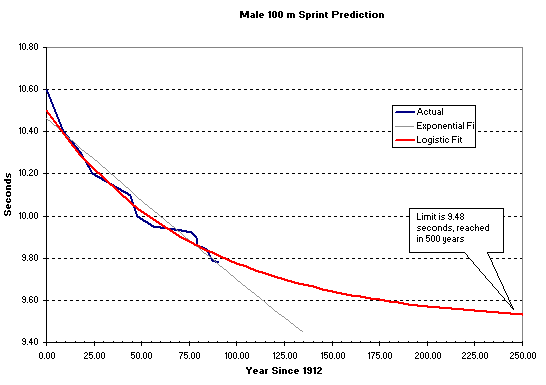
As the graph indicates, the logistic fit, linear regression and actual times for the 100 m male sprint. It would have to been interesting to follow the linear regression line and see if "theoretically" men can ever run a 0 sec 100 meter. I also wonder if Oscar Pistorius, the man with metal prosthetic limbs, can ever take us south of the limit 9.48 sec?
Monday, August 24, 2009
A problem the market might be able to solve...
Advertisers back away from talk shows
While talk show host Glenn Beck was on vacation, a lot of his advertisers left him due to his comment that President Obama is a racist. Advertisers are distancing their products from other cable news talk shows as well. Jeremy Hobson reports.
http://marketplace.publicradio.org/display/web/2009/08/24/pm-beck/
While talk show host Glenn Beck was on vacation, a lot of his advertisers left him due to his comment that President Obama is a racist. Advertisers are distancing their products from other cable news talk shows as well. Jeremy Hobson reports.
http://marketplace.publicradio.org/display/web/2009/08/24/pm-beck/
I love maps :)
So here's one I found interesting... It is a lot easier on the yes, in my opinion, if you remove the county borders.
For ex: Montgomery County, OH's unemployement rate is higher than Los Angeles's...
http://www.npr.org/templates/story/story.php?storyId=111494514
For ex: Montgomery County, OH's unemployement rate is higher than Los Angeles's...
http://www.npr.org/templates/story/story.php?storyId=111494514
Monday, August 3, 2009
Foshay (my school)'s history from our outgoing principal
ABOUT FOSHAY…
Fabulous Foshay celebrated its 80th anniversary in 2005! James A. Foshay Junior High School opened its doors for the first time in February 1925 with an enrollment of 1300 primarily white students. Today, Foshay is a multi-track, year-round Los Angeles Unified School District (LAUSD) Learning Center for over 3,100 Kindergarten through 12th grade students, 78% of whom are Latino, 21% African-American, and 1% “other.” Foshay is under the leadership of Veronique Wills, a graduate of LAUSD and the University of California system. Foshay has a diverse faculty of approximately 150 teachers and support staff, a classified staff of 150, and a thriving Parent Center, with numerous parent volunteers. Many think Foshay is a charter or magnet school, due to: our many community partnerships; being characterized as a relatively “safe” campus with calm, helpful, and polite students; a school based Health Clinic; a welcoming Parent Center; our ability to provide travel abroad for our secondary students; before and after school day care for our elementary students, and several after-school programs such as Youth Services, LA Bridges, and USC Readers, as well as various high school athletic and academic teams. However, we are just a large urban neighborhood school, which is designed and operates a little differently than many District schools.
In 1992, not satisfied with the lack of success indicators for its students at Foshay Junior High, and on the verge of being taken over by the state, under the leadership of Howard Lappin and in collaboration with the school community, Foshay restructured to an Urban Learning Center. This educational reform model includes such features as a center for mental and physical health in the form of a school based health clinic, a Parent Center, on-going meaningful professional development, and a school which spans all the grades. This is why Foshay bears the name, James A. Foshay Learning Center. Foshay also became a LEARN school, which partners with community businesses in helping to create a more structured climate conducive to teaching and learning. The vehicle selected to move and sustain our restructuring efforts was School Based Management (SBM), which continues to be overwhelming supported by stakeholders and the principal every renewal period. Collaboration is the key in SBM, and remains part of our mission statement. As a result, the principal and the teacher union’s chapter chairperson continue to work collaboratively together to improve student achievement. A very well run School Site Council of 10 students/parents and 10 staff monitors our Single Plan for Student Achievement and the school budgets and state/district grants which support it.
The restructuring has been worth it! In 1996, the state recognized the middle school as a California Distinguished School, and, since 2000, Newsweek Magazine continues to include Foshay's high school in the Top American High Schools. Since the California High School Exit Exam was instituted, Foshay high school students have performed very well, exceeding District and state averages. Each year there is a large waiting list for Foshay’s full day Kindergarten, sixth grade, and ninth grade. Foshay currently has a school wide API (the state’s Academic Performance Index) of 645, although the elementary and high school test scores meet and in most cases surpass District and state scores. (Using the state’s API calculator, Foshay’s high school’s API was calculated at over 700 in 2008. The state’s API goal for all schools is 800 on a scale of 100 -1,000).
• The elementary, is a school of choice operating on a traditional calendar for 185 students, where enrollment is via a lottery system under the District’s Open Enrollment option.
• The middle school is the school of residence for children residing in the neighborhood. However, the immediate area is so dense in population, that there has not been enough room for all middle school age students for several years, even with a year-round calendar. Thus, for the past six years or so middle school students have been bused to less crowded schools. At one time, there were up to 500 students being “capped” to other schools. Now, there is less than 100, due to decreasing enrollment in the feeder elementary schools.
• Foshay's high school, is a “school of choice,” open only to its 8th grade class, who apply and are selected through lottery for approximately 150 - 180 freshman seats. General education, Intermediate and Advanced ESL students, as well as students with IEPs for resource and itinerant services may apply. The high school of approximately 650 students offers an alternative to surrounding large District high schools, as well as private and Charter schools. From its beginnings in 1996, Foshay’s High School was designed as a college preparatory educational experience, following the A-G requirements of the UC system and divided into 3 smaller distinct learning communities, which are career/college pathways or academies: Finance, Information Technology, and Health Careers. In addition, the design has always demanded that students take 4 years of mathematics starting with geometry. Emerging in the 2006-07 school year is a new 9th grade Academy to better “groom” the type of learner Foshay expects.
When Howard Lappin retired in August 2001, then assistant principal Veronique Wills, took over the helm as principal by a 99% approval rate from all stakeholder groups under an SBM waiver. The Foshay Learning Center model continues to produce many student achievement success indicators. In 2008, Foshay's schoolwide API (Academic Performance Indicator) reached 645, a 172 point growth since 2000. Each year, 92% of Foshay seniors graduate on time, and 95% of them were accepted to college or university! Using the state’s (4 year) graduation rate criteria, Foshay’s rate exceeds the District and state’s at 86%. Advanced Studies for Gifted students in the middle school has grown over the years, as well as an abundance of Advanced Placement classes for all high school students. This year, Foshay will introduce the IB – International Baccalaureate program at the middle school and elementary levels. Foshay continues to partner with the University of Southern California, for such programs as the Neighborhood Academic Initiative (NAI)/USC (college preparatory) program for over 240 seventh through twelfth grade students, college aged tutors, social work interns, youth sports, assistance with our music department and more.
Foshay’s high school continues to receive accolades, such as being recognized in the Top 1% of American high schools (2003, 2005, 2006, 2007, 2008) by Newsweek magazine, and in 2004, the National Association of Secondary Student Principals and the Rand Corporation included Foshay as one of 12 “Breakthrough” high schools in the country (Braking Ranks I) – those with high minority, high poverty, high graduation rate, and high college acceptance rate. Foshay students continue to be accepted to top colleges and universities, such as: USC, Berkeley, Air Force Academy, Hampton, MIT, Morehouse, Yale, all the UC and CSU campuses and more. Generally, 92% of Foshay grads are accepted to college and 76% enroll in the Fall. Foshay’s college enrollment rate exceeds the District’s and the state’s.
Under Ms. Wills’ leadership, Robotics has been introduced in the middle school. In fact, Foshay entered a five year partnership with nearby Los Angeles Trade Technical College where our middle school students learn robotics and any 7th – 12th grade student can take certain academic or elective college courses in the college’s Steps Ahead Program, while they are off-track. In the past three years, AVID, Advancement Via Individual Determination, a college preparatory program, has surfaced in Foshay's middle school on all 3 tracks. Also surfacing within the past four years, is the opportunity for our middle and high school students to travel abroad, to such places as Costa Rica, England, Thailand, Italy, France, Spain, Thailand, and even, Yugoslavia, while our 5th graders have gone either to Washington D.C. every other year or weekend camping in Malibu Canyon. In addition, for the past two years the Department of Children Services and Foshay partnered to house “mPLAY,” an Academic Mentor Center on campus to better assist students in the Foster Care system. Foshay recently introduced Room 13, the international student run art gallery/workshop to the United States and LA Unified and at the high school level, NetGeneration Youth, a partnership with NASA (as the vision of Congresswoman Watson) in which high school students are cyber journalists and international students ambassadors. Prior to that Congresswoman Watson introduced us to Panwapa, where elementary students can interact electronically with “Sesame Street” like characters in other countries and learn world languages. Effective next year, we are introducing the International Baccalaureate program, to support our vision and our quest to help our students to become global citizens. These are a few of the many academic programs and/or partnerships at Foshay, that help reduce barriers to student success or add enrichment to their academic lives.
Fabulous Foshay has a dedicated staff, positive students eager to learn, a wonderful parent volunteer group, and great community partners. Like many Title I District secondary schools, Foshay is struggling to exit Program Improvement status which will occur once we meet the state’s Adequate Yearly Progress criteria. Although we make incremental positive growth in our test scores each year, under NCLB, it is quite a challenge to meet all 26 criteria for our school, with a student population of over three-thousand, 400 of whom are students with disabilities and 800 of whom are English Learners. Nevertheless, Foshay's ultimate goal is to become a High Performing School! Next year, 2009-10 will be Foshay’s last year as a year round school. Fall 2010 Foshay will open as a smaller K-12 school operating on the traditional calendar with no more than 1,895 students. Almost half of the middle school students will enroll in the new nearby Middle School #6, also to open in Fall 2010 as a traditional school of 1,400 students.
On the web at: http://www.foshaylc.org
Or, because we’re a year-round school, stop by anytime!
Fabulous Foshay celebrated its 80th anniversary in 2005! James A. Foshay Junior High School opened its doors for the first time in February 1925 with an enrollment of 1300 primarily white students. Today, Foshay is a multi-track, year-round Los Angeles Unified School District (LAUSD) Learning Center for over 3,100 Kindergarten through 12th grade students, 78% of whom are Latino, 21% African-American, and 1% “other.” Foshay is under the leadership of Veronique Wills, a graduate of LAUSD and the University of California system. Foshay has a diverse faculty of approximately 150 teachers and support staff, a classified staff of 150, and a thriving Parent Center, with numerous parent volunteers. Many think Foshay is a charter or magnet school, due to: our many community partnerships; being characterized as a relatively “safe” campus with calm, helpful, and polite students; a school based Health Clinic; a welcoming Parent Center; our ability to provide travel abroad for our secondary students; before and after school day care for our elementary students, and several after-school programs such as Youth Services, LA Bridges, and USC Readers, as well as various high school athletic and academic teams. However, we are just a large urban neighborhood school, which is designed and operates a little differently than many District schools.
In 1992, not satisfied with the lack of success indicators for its students at Foshay Junior High, and on the verge of being taken over by the state, under the leadership of Howard Lappin and in collaboration with the school community, Foshay restructured to an Urban Learning Center. This educational reform model includes such features as a center for mental and physical health in the form of a school based health clinic, a Parent Center, on-going meaningful professional development, and a school which spans all the grades. This is why Foshay bears the name, James A. Foshay Learning Center. Foshay also became a LEARN school, which partners with community businesses in helping to create a more structured climate conducive to teaching and learning. The vehicle selected to move and sustain our restructuring efforts was School Based Management (SBM), which continues to be overwhelming supported by stakeholders and the principal every renewal period. Collaboration is the key in SBM, and remains part of our mission statement. As a result, the principal and the teacher union’s chapter chairperson continue to work collaboratively together to improve student achievement. A very well run School Site Council of 10 students/parents and 10 staff monitors our Single Plan for Student Achievement and the school budgets and state/district grants which support it.
The restructuring has been worth it! In 1996, the state recognized the middle school as a California Distinguished School, and, since 2000, Newsweek Magazine continues to include Foshay's high school in the Top American High Schools. Since the California High School Exit Exam was instituted, Foshay high school students have performed very well, exceeding District and state averages. Each year there is a large waiting list for Foshay’s full day Kindergarten, sixth grade, and ninth grade. Foshay currently has a school wide API (the state’s Academic Performance Index) of 645, although the elementary and high school test scores meet and in most cases surpass District and state scores. (Using the state’s API calculator, Foshay’s high school’s API was calculated at over 700 in 2008. The state’s API goal for all schools is 800 on a scale of 100 -1,000).
• The elementary, is a school of choice operating on a traditional calendar for 185 students, where enrollment is via a lottery system under the District’s Open Enrollment option.
• The middle school is the school of residence for children residing in the neighborhood. However, the immediate area is so dense in population, that there has not been enough room for all middle school age students for several years, even with a year-round calendar. Thus, for the past six years or so middle school students have been bused to less crowded schools. At one time, there were up to 500 students being “capped” to other schools. Now, there is less than 100, due to decreasing enrollment in the feeder elementary schools.
• Foshay's high school, is a “school of choice,” open only to its 8th grade class, who apply and are selected through lottery for approximately 150 - 180 freshman seats. General education, Intermediate and Advanced ESL students, as well as students with IEPs for resource and itinerant services may apply. The high school of approximately 650 students offers an alternative to surrounding large District high schools, as well as private and Charter schools. From its beginnings in 1996, Foshay’s High School was designed as a college preparatory educational experience, following the A-G requirements of the UC system and divided into 3 smaller distinct learning communities, which are career/college pathways or academies: Finance, Information Technology, and Health Careers. In addition, the design has always demanded that students take 4 years of mathematics starting with geometry. Emerging in the 2006-07 school year is a new 9th grade Academy to better “groom” the type of learner Foshay expects.
When Howard Lappin retired in August 2001, then assistant principal Veronique Wills, took over the helm as principal by a 99% approval rate from all stakeholder groups under an SBM waiver. The Foshay Learning Center model continues to produce many student achievement success indicators. In 2008, Foshay's schoolwide API (Academic Performance Indicator) reached 645, a 172 point growth since 2000. Each year, 92% of Foshay seniors graduate on time, and 95% of them were accepted to college or university! Using the state’s (4 year) graduation rate criteria, Foshay’s rate exceeds the District and state’s at 86%. Advanced Studies for Gifted students in the middle school has grown over the years, as well as an abundance of Advanced Placement classes for all high school students. This year, Foshay will introduce the IB – International Baccalaureate program at the middle school and elementary levels. Foshay continues to partner with the University of Southern California, for such programs as the Neighborhood Academic Initiative (NAI)/USC (college preparatory) program for over 240 seventh through twelfth grade students, college aged tutors, social work interns, youth sports, assistance with our music department and more.
Foshay’s high school continues to receive accolades, such as being recognized in the Top 1% of American high schools (2003, 2005, 2006, 2007, 2008) by Newsweek magazine, and in 2004, the National Association of Secondary Student Principals and the Rand Corporation included Foshay as one of 12 “Breakthrough” high schools in the country (Braking Ranks I) – those with high minority, high poverty, high graduation rate, and high college acceptance rate. Foshay students continue to be accepted to top colleges and universities, such as: USC, Berkeley, Air Force Academy, Hampton, MIT, Morehouse, Yale, all the UC and CSU campuses and more. Generally, 92% of Foshay grads are accepted to college and 76% enroll in the Fall. Foshay’s college enrollment rate exceeds the District’s and the state’s.
Under Ms. Wills’ leadership, Robotics has been introduced in the middle school. In fact, Foshay entered a five year partnership with nearby Los Angeles Trade Technical College where our middle school students learn robotics and any 7th – 12th grade student can take certain academic or elective college courses in the college’s Steps Ahead Program, while they are off-track. In the past three years, AVID, Advancement Via Individual Determination, a college preparatory program, has surfaced in Foshay's middle school on all 3 tracks. Also surfacing within the past four years, is the opportunity for our middle and high school students to travel abroad, to such places as Costa Rica, England, Thailand, Italy, France, Spain, Thailand, and even, Yugoslavia, while our 5th graders have gone either to Washington D.C. every other year or weekend camping in Malibu Canyon. In addition, for the past two years the Department of Children Services and Foshay partnered to house “mPLAY,” an Academic Mentor Center on campus to better assist students in the Foster Care system. Foshay recently introduced Room 13, the international student run art gallery/workshop to the United States and LA Unified and at the high school level, NetGeneration Youth, a partnership with NASA (as the vision of Congresswoman Watson) in which high school students are cyber journalists and international students ambassadors. Prior to that Congresswoman Watson introduced us to Panwapa, where elementary students can interact electronically with “Sesame Street” like characters in other countries and learn world languages. Effective next year, we are introducing the International Baccalaureate program, to support our vision and our quest to help our students to become global citizens. These are a few of the many academic programs and/or partnerships at Foshay, that help reduce barriers to student success or add enrichment to their academic lives.
Fabulous Foshay has a dedicated staff, positive students eager to learn, a wonderful parent volunteer group, and great community partners. Like many Title I District secondary schools, Foshay is struggling to exit Program Improvement status which will occur once we meet the state’s Adequate Yearly Progress criteria. Although we make incremental positive growth in our test scores each year, under NCLB, it is quite a challenge to meet all 26 criteria for our school, with a student population of over three-thousand, 400 of whom are students with disabilities and 800 of whom are English Learners. Nevertheless, Foshay's ultimate goal is to become a High Performing School! Next year, 2009-10 will be Foshay’s last year as a year round school. Fall 2010 Foshay will open as a smaller K-12 school operating on the traditional calendar with no more than 1,895 students. Almost half of the middle school students will enroll in the new nearby Middle School #6, also to open in Fall 2010 as a traditional school of 1,400 students.
On the web at: http://www.foshaylc.org
Or, because we’re a year-round school, stop by anytime!
Friday, July 24, 2009
Cyber -Dissidents
Senate to Hillary: Support Cyber-Dissidents
By DAVID FEITH
This month, amid record profligacy on Capitol Hill, Sens. Sam Brownback (R., Kan.) and Arlen Specter (D., Pa.) pushed for spending that all Americans can celebrate: $30 million of the Senate’s State Department appropriations bill will go to support digital tools for undermining Internet censorship. If the initiative is properly implemented, the politically repressed from Havana to Rangoon will have cause for celebration.
Authoritarian regimes spend fortunes censoring the Internet because they fear the subversive potential of digital communications. China and Iran are world leaders in this regard—models for other rogues such as Syria and Saudi Arabia.
In countering the Green Revolution this summer, Iran unveiled a new high-tech apparatus for blocking some Internet communications outright, while monitoring others in order to intimidate dissenters. China uses more than 40,000 censors in a dozen government agencies to limit Web content via the so-called Great Firewall. As Chinese President Hu Jintao said in 2007: “Whether we can cope with the Internet is a matter that affects the development of socialist culture, the security of information and the stability of the state.”
The Soviet Union felt similarly about the Berlin Wall. Just as East Germans diminished Soviet legitimacy by escaping across Checkpoint Charlie, “hacktivists” today do the same by breaching Internet cyberwalls. Which is why, as the bill says, the Senate is funding groups with “scalable, field tested programs . . . for large numbers of users living in closed societies.”
Arguably the most important of these groups is the Global Internet Freedom Consortium (GIF), whose software has been critical in Iran. During the protests of June 20 alone, more than one million Iranians used GIF tools to visit 390 million pages on the uncensored Internet.
GIF has an impressive history of aiding anti-authoritarian movements in real time. When Burmese monks and others rose up against their military rulers in August 2007, its programs saw a threefold increase in average daily hits from Burma. During the March 2008 anti-Beijing protests in Tibet, Tibetan usage of GIF’s tools rose by 300%.
The consortium was launched in 2000 by Chinese-American practitioners of Falun Gong, the spiritual group persecuted by Beijing. Using computers in data centers scattered around the world, it provides a series of programs that can be easily downloaded or distributed by email. The programs allow users to bypass censored domestic servers and access the Internet via GIF’s foreign servers. Users in Damascus can make the same Google searches as users in New York, without leaving a trace.
The widespread use of GIF’s technologies among Falun Gong practitioners and others has infuriated Beijing. So concerned is China with GIF that when the American technology giant Cisco solicited the Chinese government’s business in 2002, it did so by explaining how its technologies could help “combat the ‘Falun Gong’ evil cult.”
But Cisco’s pitch—contained in a PowerPoint presentation later obtained by GIF and presented before Congress last year—was for naught. Despite Beijing’s efforts to neutralize it, GIF has become so popular that it’s had trouble accommodating demand.
World demand approaches 10 million unique users per day, but GIF has capacity for only about 1.2 million. So when Iranians flooded its servers last month, GIF had to block usage temporarily to preserve capacity. Iranians sent the group thousands of messages pleading for restoration. Without GIF’s tools, one user wrote, “we have no contact with true data and true news.”
Were $30 million added to its volunteer-driven operation, GIF would reportedly be able to accommodate more than 50 million unique users per day.
But this opportunity could yet be squandered. First, members of the House and Senate will decide in conference whether to appropriate the Senate’s full $30 million, or a sum closer to the $15 million contained in the House’s version of the bill.
More worrying is that Congress’s funding will go to the State Department, where deference to the world’s worst regimes too often takes precedence over human rights. Funding programs like GIF will doubtless anger leaders in Beijing and Tehran with whom the Obama administration seeks engagement. Yet pursuing the favor of such leaders by misallocating these Internet freedom funds would be a grave mistake.
It would not be unprecedented, though. The 2004 North Korea Human Rights Act was another welcome congressional effort that would have furthered human rights, in that case by aiding North Korean refugees. The law angered Beijing, which opposes anything that might encourage North Koreans to flee their neo-Stalinist prison. So the State Department—unjustifiably hoping that China would help the U.S. disarm North Korea—ignored or undermined the law’s intentions at every turn, severely limiting diplomatic, legal and humanitarian assistance to refugees.
Will the State Department again bow to tyrants, or follow Congress’s guidelines? Millions of would-be cyber-dissidents are waiting.
Mr. Feith is a Robert L. Bartley fellow at the Journal this summer.
By DAVID FEITH
This month, amid record profligacy on Capitol Hill, Sens. Sam Brownback (R., Kan.) and Arlen Specter (D., Pa.) pushed for spending that all Americans can celebrate: $30 million of the Senate’s State Department appropriations bill will go to support digital tools for undermining Internet censorship. If the initiative is properly implemented, the politically repressed from Havana to Rangoon will have cause for celebration.
Authoritarian regimes spend fortunes censoring the Internet because they fear the subversive potential of digital communications. China and Iran are world leaders in this regard—models for other rogues such as Syria and Saudi Arabia.
In countering the Green Revolution this summer, Iran unveiled a new high-tech apparatus for blocking some Internet communications outright, while monitoring others in order to intimidate dissenters. China uses more than 40,000 censors in a dozen government agencies to limit Web content via the so-called Great Firewall. As Chinese President Hu Jintao said in 2007: “Whether we can cope with the Internet is a matter that affects the development of socialist culture, the security of information and the stability of the state.”
The Soviet Union felt similarly about the Berlin Wall. Just as East Germans diminished Soviet legitimacy by escaping across Checkpoint Charlie, “hacktivists” today do the same by breaching Internet cyberwalls. Which is why, as the bill says, the Senate is funding groups with “scalable, field tested programs . . . for large numbers of users living in closed societies.”
Arguably the most important of these groups is the Global Internet Freedom Consortium (GIF), whose software has been critical in Iran. During the protests of June 20 alone, more than one million Iranians used GIF tools to visit 390 million pages on the uncensored Internet.
GIF has an impressive history of aiding anti-authoritarian movements in real time. When Burmese monks and others rose up against their military rulers in August 2007, its programs saw a threefold increase in average daily hits from Burma. During the March 2008 anti-Beijing protests in Tibet, Tibetan usage of GIF’s tools rose by 300%.
The consortium was launched in 2000 by Chinese-American practitioners of Falun Gong, the spiritual group persecuted by Beijing. Using computers in data centers scattered around the world, it provides a series of programs that can be easily downloaded or distributed by email. The programs allow users to bypass censored domestic servers and access the Internet via GIF’s foreign servers. Users in Damascus can make the same Google searches as users in New York, without leaving a trace.
The widespread use of GIF’s technologies among Falun Gong practitioners and others has infuriated Beijing. So concerned is China with GIF that when the American technology giant Cisco solicited the Chinese government’s business in 2002, it did so by explaining how its technologies could help “combat the ‘Falun Gong’ evil cult.”
But Cisco’s pitch—contained in a PowerPoint presentation later obtained by GIF and presented before Congress last year—was for naught. Despite Beijing’s efforts to neutralize it, GIF has become so popular that it’s had trouble accommodating demand.
World demand approaches 10 million unique users per day, but GIF has capacity for only about 1.2 million. So when Iranians flooded its servers last month, GIF had to block usage temporarily to preserve capacity. Iranians sent the group thousands of messages pleading for restoration. Without GIF’s tools, one user wrote, “we have no contact with true data and true news.”
Were $30 million added to its volunteer-driven operation, GIF would reportedly be able to accommodate more than 50 million unique users per day.
But this opportunity could yet be squandered. First, members of the House and Senate will decide in conference whether to appropriate the Senate’s full $30 million, or a sum closer to the $15 million contained in the House’s version of the bill.
More worrying is that Congress’s funding will go to the State Department, where deference to the world’s worst regimes too often takes precedence over human rights. Funding programs like GIF will doubtless anger leaders in Beijing and Tehran with whom the Obama administration seeks engagement. Yet pursuing the favor of such leaders by misallocating these Internet freedom funds would be a grave mistake.
It would not be unprecedented, though. The 2004 North Korea Human Rights Act was another welcome congressional effort that would have furthered human rights, in that case by aiding North Korean refugees. The law angered Beijing, which opposes anything that might encourage North Koreans to flee their neo-Stalinist prison. So the State Department—unjustifiably hoping that China would help the U.S. disarm North Korea—ignored or undermined the law’s intentions at every turn, severely limiting diplomatic, legal and humanitarian assistance to refugees.
Will the State Department again bow to tyrants, or follow Congress’s guidelines? Millions of would-be cyber-dissidents are waiting.
Mr. Feith is a Robert L. Bartley fellow at the Journal this summer.
Jupiter Gets a Black Eye
By MICHIO KAKU
We sometimes forget that the universe is a violent place.
This week, astronomers in Hawaii recorded an exceedingly rare event. An amazing photograph revealed a comet or asteroid, probably no more than a mile across, plowing into Jupiter’s atmosphere. The impact created a fireball roughly the size of the planet earth.
The good news is that Jupiter was just doing its job, cleaning out the solar system of stray comets and asteroids. Jupiter, 318 times more massive than the earth, acts like a cosmic vacuum cleaner, sucking in or deflecting debris left over from the solar system’s birth 4.5 billion years ago. If it weren’t for Jupiter’s colossal gravitational field, we wouldn’t be here, since the earth would be hit with deadly comet and meteor impacts every month or so. Most of the U.S. would just be an empty graveyard of bleak craters.
The bad news is that a comet impact could happen to us. A black eye for Jupiter would be a body blow to the earth. We got a taste of this back in 1908, when something the size of an apartment building plowed into Tunguska, Siberia. This “city-buster” flattened 100 million trees with the force of a hydrogen bomb. But this recent Jupiter comet, much larger and coming in at perhaps 100,000 miles per hour, would have unleashed the power of hundreds of H-bombs. It might have engulfed most of the East Coast in a huge firestorm, triggering a massive tsunami and destabilizing the weather.
According to Hollywood, we can always send our astronauts on a space shuttle to intercept a comet and blow it up with H-bombs. Wrong. Blowing up a comet with nuclear bombs creates chunks of debris, increasing the area of destruction. So we are sitting ducks to a potential impact from deep space.
So what’s the lesson from all of this?
Maybe Mother Nature has a sense of humor. An impact like the recent one in Jupiter happened 15 years ago, in late July, after the Shoemaker-Levy 9 comet broke up into 20 pieces, each of which plunged into Jupiter, creating a dazzling display of cosmic fireworks. Scientists used to believe that these collisions took place once every few thousand years, not 15 years. So perhaps Mother Nature was just trying to show what little scientists really understand about these cosmic collisions.
But it also happened on the 40th anniversary of the moon landing. So maybe Mother Nature was reminding us that the universe is, after all, a violent place—that we may one day need a new home. The earth lies in the middle of a cosmic shooting gallery. The proof comes out every night when we gaze at the moon.
When viewing the film of Neil Armstrong and Buzz Aldrin bobbing among the barren craters of the moon, we are reminded that each crater was gouged out by a titanic impact.
In addition, there are more than 5,000 so-called near-earth objects, carefully tracked by telescope, that can cross near the orbit of the earth. One of them, the asteroid Apophis, is about the size of the Rose Bowl. It will graze the earth in 2029 and again in 2036, passing below some of our satellites.
But there are also many unnamed comets outside the solar system whose orbits are totally unknown and unpredictable. They would give us little warning and catch us totally off-guard, like the comet that just hit Jupiter.
So in the long term, perhaps we should look at the space program as an insurance policy. Not only has the space program given us a bonanza of benefits (such as weather satellites, the Global Positioning System, telecommunications, etc.), it also provides a gateway to the stars. Over the course of the next few centuries, maybe we should use that gateway to plan to be a “two planet species.” Life is too precious to place in one basket.
In August, President Barack Obama will receive a major report from the U.S. human space flight plans committee about the future of space travel, which could be a turning point for NASA in the 21st century. He should remember the Jupiter hit as he considers the report.
Mr. Kaku is the author of “Physics of the Impossible: a Scientific Exploration into the World of Phasers, Force Fields, Teleportation, and Time Travel” (Doubleday, 2008).
By MICHIO KAKU
We sometimes forget that the universe is a violent place.
This week, astronomers in Hawaii recorded an exceedingly rare event. An amazing photograph revealed a comet or asteroid, probably no more than a mile across, plowing into Jupiter’s atmosphere. The impact created a fireball roughly the size of the planet earth.
The good news is that Jupiter was just doing its job, cleaning out the solar system of stray comets and asteroids. Jupiter, 318 times more massive than the earth, acts like a cosmic vacuum cleaner, sucking in or deflecting debris left over from the solar system’s birth 4.5 billion years ago. If it weren’t for Jupiter’s colossal gravitational field, we wouldn’t be here, since the earth would be hit with deadly comet and meteor impacts every month or so. Most of the U.S. would just be an empty graveyard of bleak craters.
The bad news is that a comet impact could happen to us. A black eye for Jupiter would be a body blow to the earth. We got a taste of this back in 1908, when something the size of an apartment building plowed into Tunguska, Siberia. This “city-buster” flattened 100 million trees with the force of a hydrogen bomb. But this recent Jupiter comet, much larger and coming in at perhaps 100,000 miles per hour, would have unleashed the power of hundreds of H-bombs. It might have engulfed most of the East Coast in a huge firestorm, triggering a massive tsunami and destabilizing the weather.
According to Hollywood, we can always send our astronauts on a space shuttle to intercept a comet and blow it up with H-bombs. Wrong. Blowing up a comet with nuclear bombs creates chunks of debris, increasing the area of destruction. So we are sitting ducks to a potential impact from deep space.
So what’s the lesson from all of this?
Maybe Mother Nature has a sense of humor. An impact like the recent one in Jupiter happened 15 years ago, in late July, after the Shoemaker-Levy 9 comet broke up into 20 pieces, each of which plunged into Jupiter, creating a dazzling display of cosmic fireworks. Scientists used to believe that these collisions took place once every few thousand years, not 15 years. So perhaps Mother Nature was just trying to show what little scientists really understand about these cosmic collisions.
But it also happened on the 40th anniversary of the moon landing. So maybe Mother Nature was reminding us that the universe is, after all, a violent place—that we may one day need a new home. The earth lies in the middle of a cosmic shooting gallery. The proof comes out every night when we gaze at the moon.
When viewing the film of Neil Armstrong and Buzz Aldrin bobbing among the barren craters of the moon, we are reminded that each crater was gouged out by a titanic impact.
In addition, there are more than 5,000 so-called near-earth objects, carefully tracked by telescope, that can cross near the orbit of the earth. One of them, the asteroid Apophis, is about the size of the Rose Bowl. It will graze the earth in 2029 and again in 2036, passing below some of our satellites.
But there are also many unnamed comets outside the solar system whose orbits are totally unknown and unpredictable. They would give us little warning and catch us totally off-guard, like the comet that just hit Jupiter.
So in the long term, perhaps we should look at the space program as an insurance policy. Not only has the space program given us a bonanza of benefits (such as weather satellites, the Global Positioning System, telecommunications, etc.), it also provides a gateway to the stars. Over the course of the next few centuries, maybe we should use that gateway to plan to be a “two planet species.” Life is too precious to place in one basket.
In August, President Barack Obama will receive a major report from the U.S. human space flight plans committee about the future of space travel, which could be a turning point for NASA in the 21st century. He should remember the Jupiter hit as he considers the report.
Mr. Kaku is the author of “Physics of the Impossible: a Scientific Exploration into the World of Phasers, Force Fields, Teleportation, and Time Travel” (Doubleday, 2008).
Sunday, July 19, 2009
They put a man on the moon, and a comedian in the Senate.
Sotomayor Hearing Escapes Gravity
They put a man on the moon, and a comedian in the Senate.
By PEGGY NOONAN
Everyone is noting the 40th anniversary, on July 20, of the moon landing. Good. It was an epic moment in history, though its memory is accompanied by an unsatisfied feeling, as if Columbus came to America and then no one followed. People will ask again why we've stopped visiting other places and have instead spent the past few decades watching the space shuttle orbit the Earth. There are many reasons for this (budgets, the end of the space race, an inability to understand the human imagination) but let me throw forward this one: The space program of the past 32 years unconsciously mirrored a change in American psychology. Once, we saw ourselves as a breakthrough people, a nation with a mission to push beyond ourselves. Now, in the age of soft narcissism, we just circle ourselves. Which is what the shuttle does: It is on an endless loop, going 'round and 'round and looking down at: us.
We should take our eyes off ourselves. We should go someplace again. It would remind us who we've been, which would remind us who we are.
Something about the steely-eyed rocket men of the Mercury and Apollo programs: They weren't criers. Now, on TV every day as people remember some trauma or triumph, they stop as if on cue—they know this is expected of them—and weep. They think this shows sincerity and sensitivity. But they feel too much about their struggles. I sometimes watch with fascination those shows where people lose weight. They often begin to sob as they fall off the treadmill or remember the Twinkie they didn't eat. This is now the national style. It makes Europeans laugh. When they're about to be mawkish or overly emotional they say, "I don't mean to get American on you." The men who took the moon will be all over TV the next few days. I bet they don't cry as they remember "Tranquility Base here, the Eagle has landed." How moving their dry eyes will be.
* * *
The Sotomayor hearings were unsatisfying and relatively unilluminating. She was moderate in tone and manner, said little, will be confirmed, and over the years, decision by decision, we will find out who she is and how she thinks. They're all a mystery going in and then, paradoxically, cover themselves in a long black robe and reveal themselves. The Republicans questioning her never seemed to gain purchase, never quite succeeded in making the interesting (the Ricci case) interesting. Looking at things shallowly, and let's, Sonia Sotomayor seemed weirdly overrehearsed, speaking v e r y s l o w l y, gesturing with her hands in a way that was no doubt supposed to look natural and warm, like grandma in the kitchen, but instead came across as artificial and mildly animatronic.
She took refuge (as did some of her questioners) in the impenetrable language of the law, and in what seemed (and this is becoming a regular strategy in politics) to be the deliberate jumbling of syntax, so people at home won't be able to follow what is being said. To be clear and succinct is to look for trouble. Better to produce a mist and miasma of jumbly words, and sentences that do not hold. You're talking, so you'll seem alive—in fact people using the syntax dodge are often quite animated—but as to meaning, you can leave that to the TV producers, who'll wrestle around trying to get something that makes sense and then settle for the Perry Mason soundbite. (Well, in truth the Perry Mason soundbite is pretty much what they want.)
I suspect the hearings added to a general sense of Washington's surface comity and essential sketchiness.
* * *
The new senator from Minnesota, Al Franken, signaled in his questioning that he will spend the next few years playing the part of the reasonable fellow who's awed to be here, eager to learn and ready to work. He's doing a Full Hillary. When Mrs. Clinton entered the Senate 8 years ago, there was about her the constant air of fisticuffs and scandal. But she did the absolute commonsense thing, keeping her head down and charming people with her hardworking, non-
Diva-like attitude. This was not only a great move, which opened her to subsequent journalistic reassessments, it was also probably an actual relief for her. Removed from the daily grind of White House attack-and-defend, with a solid six-year sinecure, she was free for the first time to be what she likely wanted to be when she started out. She tapped into the part of her that really was a policy wonk who wanted to work on legislation, wanted to be liked, and wanted, even, to like. She tapped into her seriousness. We will see if Mr. Franken has any to tap into.
He will devote his time to appearing affable, speaking in a faux regular guy language—the Perry Mason question was his—curbing his crazy, and working well with the big fat lying liars on the other side. His job is to make Minnesota happy he's there so he can stay longer.
* * *
Mrs. Clinton is in a different position now. By this spring it must have become apparent to her that when the nice new president came and offered her the secretary of state job, and she said yes, she got rolled. What he got was clear: He took her off the chessboard. She wouldn't be in the Senate being a counterforce, wouldn't be planning her next move or become the rallying point of anti-Obama Democrats. She'd be on board, part of the team and invested in the administration's success, for now its success would ensure her future. If their relationship didn't work, nobody would think it was his fault.
What she would not have known was that she would be a public face of American diplomacy—not the face but a face—and not a decisive inside power. The portfolio for key areas—Afghanistan, Pakistan, the Mideast—was day by day given to others. She was sent off to do interviews on "Good Morning Manila." In a foreign-affairs apparatus of clashing egos, she'd be just another ego. A Henry Kissinger or George Shultz would never have allowed this. She didn't even go to the G-8 or the Russia meeting. President Obama, that canny fellow, only wants Obama in the room. It is true she broke her elbow, but they make it sound like a farming accident where her elbow was torn from her arm as she fed the thresher. Tina Brown wrote a witty column saying Mr. Obama should let Hillary out of her burqa.
But you know, one thing Mrs. Clinton's learned is how to wait. Things turn on a dime, you wake up in the morning and there's a new headline that changes everything. Sooner or later Mr. Obama is going to get in trouble, sooner or later the trouble will take hold and settle in, and sooner or later she will be the unsullied one who quietly did her duty in spite of the slights to which she's been subjected. And when that happens, she will emerge—reluctantly, painfully—as the Democratic alternative. The one who almost won, who knew—who learned the hard way—that you can't do everything all at once, that it's the economy, stupid.
They will look like kids playing with history. Hillary isn't a kid. She's experienced, and has been roughed up by history. Watch. She'll roll right back.
They put a man on the moon, and a comedian in the Senate.
By PEGGY NOONAN
Everyone is noting the 40th anniversary, on July 20, of the moon landing. Good. It was an epic moment in history, though its memory is accompanied by an unsatisfied feeling, as if Columbus came to America and then no one followed. People will ask again why we've stopped visiting other places and have instead spent the past few decades watching the space shuttle orbit the Earth. There are many reasons for this (budgets, the end of the space race, an inability to understand the human imagination) but let me throw forward this one: The space program of the past 32 years unconsciously mirrored a change in American psychology. Once, we saw ourselves as a breakthrough people, a nation with a mission to push beyond ourselves. Now, in the age of soft narcissism, we just circle ourselves. Which is what the shuttle does: It is on an endless loop, going 'round and 'round and looking down at: us.
We should take our eyes off ourselves. We should go someplace again. It would remind us who we've been, which would remind us who we are.
Something about the steely-eyed rocket men of the Mercury and Apollo programs: They weren't criers. Now, on TV every day as people remember some trauma or triumph, they stop as if on cue—they know this is expected of them—and weep. They think this shows sincerity and sensitivity. But they feel too much about their struggles. I sometimes watch with fascination those shows where people lose weight. They often begin to sob as they fall off the treadmill or remember the Twinkie they didn't eat. This is now the national style. It makes Europeans laugh. When they're about to be mawkish or overly emotional they say, "I don't mean to get American on you." The men who took the moon will be all over TV the next few days. I bet they don't cry as they remember "Tranquility Base here, the Eagle has landed." How moving their dry eyes will be.
* * *
The Sotomayor hearings were unsatisfying and relatively unilluminating. She was moderate in tone and manner, said little, will be confirmed, and over the years, decision by decision, we will find out who she is and how she thinks. They're all a mystery going in and then, paradoxically, cover themselves in a long black robe and reveal themselves. The Republicans questioning her never seemed to gain purchase, never quite succeeded in making the interesting (the Ricci case) interesting. Looking at things shallowly, and let's, Sonia Sotomayor seemed weirdly overrehearsed, speaking v e r y s l o w l y, gesturing with her hands in a way that was no doubt supposed to look natural and warm, like grandma in the kitchen, but instead came across as artificial and mildly animatronic.
She took refuge (as did some of her questioners) in the impenetrable language of the law, and in what seemed (and this is becoming a regular strategy in politics) to be the deliberate jumbling of syntax, so people at home won't be able to follow what is being said. To be clear and succinct is to look for trouble. Better to produce a mist and miasma of jumbly words, and sentences that do not hold. You're talking, so you'll seem alive—in fact people using the syntax dodge are often quite animated—but as to meaning, you can leave that to the TV producers, who'll wrestle around trying to get something that makes sense and then settle for the Perry Mason soundbite. (Well, in truth the Perry Mason soundbite is pretty much what they want.)
I suspect the hearings added to a general sense of Washington's surface comity and essential sketchiness.
* * *
The new senator from Minnesota, Al Franken, signaled in his questioning that he will spend the next few years playing the part of the reasonable fellow who's awed to be here, eager to learn and ready to work. He's doing a Full Hillary. When Mrs. Clinton entered the Senate 8 years ago, there was about her the constant air of fisticuffs and scandal. But she did the absolute commonsense thing, keeping her head down and charming people with her hardworking, non-
Diva-like attitude. This was not only a great move, which opened her to subsequent journalistic reassessments, it was also probably an actual relief for her. Removed from the daily grind of White House attack-and-defend, with a solid six-year sinecure, she was free for the first time to be what she likely wanted to be when she started out. She tapped into the part of her that really was a policy wonk who wanted to work on legislation, wanted to be liked, and wanted, even, to like. She tapped into her seriousness. We will see if Mr. Franken has any to tap into.
He will devote his time to appearing affable, speaking in a faux regular guy language—the Perry Mason question was his—curbing his crazy, and working well with the big fat lying liars on the other side. His job is to make Minnesota happy he's there so he can stay longer.
* * *
Mrs. Clinton is in a different position now. By this spring it must have become apparent to her that when the nice new president came and offered her the secretary of state job, and she said yes, she got rolled. What he got was clear: He took her off the chessboard. She wouldn't be in the Senate being a counterforce, wouldn't be planning her next move or become the rallying point of anti-Obama Democrats. She'd be on board, part of the team and invested in the administration's success, for now its success would ensure her future. If their relationship didn't work, nobody would think it was his fault.
What she would not have known was that she would be a public face of American diplomacy—not the face but a face—and not a decisive inside power. The portfolio for key areas—Afghanistan, Pakistan, the Mideast—was day by day given to others. She was sent off to do interviews on "Good Morning Manila." In a foreign-affairs apparatus of clashing egos, she'd be just another ego. A Henry Kissinger or George Shultz would never have allowed this. She didn't even go to the G-8 or the Russia meeting. President Obama, that canny fellow, only wants Obama in the room. It is true she broke her elbow, but they make it sound like a farming accident where her elbow was torn from her arm as she fed the thresher. Tina Brown wrote a witty column saying Mr. Obama should let Hillary out of her burqa.
But you know, one thing Mrs. Clinton's learned is how to wait. Things turn on a dime, you wake up in the morning and there's a new headline that changes everything. Sooner or later Mr. Obama is going to get in trouble, sooner or later the trouble will take hold and settle in, and sooner or later she will be the unsullied one who quietly did her duty in spite of the slights to which she's been subjected. And when that happens, she will emerge—reluctantly, painfully—as the Democratic alternative. The one who almost won, who knew—who learned the hard way—that you can't do everything all at once, that it's the economy, stupid.
They will look like kids playing with history. Hillary isn't a kid. She's experienced, and has been roughed up by history. Watch. She'll roll right back.
Friday, July 10, 2009
Why We'll Leave L.A.(buisness)
Why We'll Leave L.A.
The business climate is worse than the air quality
by RICK NEWCOMBE
Los Angeles
If New Yorkers fantasize that doing business here in Los Angeles would be less of a headache, forget about it. This city is fast becoming a job-killing machine. It's no accident the unemployment rate is a frightening 11.4% and climbing.
I never could have imagined that, after living here for more than three decades, I would be filing a lawsuit against my beloved Los Angeles and making plans for my company, Creators Syndicate, to move elsewhere.
But we have no choice. The city's bureaucrats rival Stalin's apparatchiks in issuing decrees, rescinding them, and then punishing citizens for having followed them in the first place.
I founded Creators Syndicate in 1987, and we have represented hundreds of important writers, syndicating their columns to newspapers and Web sites around the world. The most famous include Hillary Clinton, who, like Eleanor Roosevelt, wrote a syndicated column when she was first lady. Another star was the advice columnist Ann Landers, once described by "The World Almanac" as "the most influential woman in America." Other Creators columnists include Bill O'Reilly, Susan Estrich, Thomas Sowell, Roland Martin and Michelle Malkin -- plus Pulitzer Prize-winning political cartoonists and your favorite comic strips.
From the beginning, we've been headquartered in Los Angeles. But 15 years ago we had a dispute with the city over our business tax classification. The city argued that we should be in an "occupations and professions" classification that has an extremely high tax rate, while we fought for a "wholesale and retail" classification with a much lower rate. The city forced us to invest a small fortune in legal fees over two years, but we felt it was worth it in order to establish the correct classification once and for all.
After enduring a series of bureaucratic hearings, we anxiously awaited a ruling to find out what our tax rate would be. Everything was at stake. We had already decided that if we lost, we would move.
You can imagine how relieved we were on July 1, 1994, when the ruling was issued. We won, and firmly planted our roots in the City of Angels and proceeded to build our business.
Everything was fine until the city started running out of money in 2007. Suddenly, the city announced that it was going to ignore its own ruling and reclassify us in the higher tax category. Even more incredible is the fact that the new classification was to be imposed retroactively to 2004 with interest and penalties. No explanation was given for the new classification, or for the city's decision to ignore its 1994 ruling.
Their official position is that the city is not bound by past rulings -- only taxpayers are. This is why we have been forced to file a lawsuit. We will let the courts decide whether it is legal for adverse rulings to apply only to taxpayers and not to the city.
We work with hundreds of outside agents, consultants, independent contractors and support services -- many of whom pay taxes to the city of Los Angeles. This spurs a job-creating ripple effect on the city's economy. Yet I suspect many companies like ours already have quietly left town in the face of the city's taxes and regulations. This would help explain the erosion of jobs.
Regardless of the outcome of our case, the arbitrary and capricious behavior of some bureaucrats is creating a lose-lose situation for everyone involved. If we win in court, the taxpayers of Los Angeles will have lost because all those tax dollars will have been wasted on needless litigation.
If we lose in court, the remaining taxpayers in Los Angeles will have lost because their burden will continue to swell as yet another business moves its jobs -- and taxpayers -- to another city.
As long as City Hall operates like a banana republic, why is anyone surprised that jobs have left the city in droves and Los Angeles is teetering on the brink of bankruptcy?
Mr. Newcombe is president of Creators Syndicate
The business climate is worse than the air quality
by RICK NEWCOMBE
Los Angeles
If New Yorkers fantasize that doing business here in Los Angeles would be less of a headache, forget about it. This city is fast becoming a job-killing machine. It's no accident the unemployment rate is a frightening 11.4% and climbing.
I never could have imagined that, after living here for more than three decades, I would be filing a lawsuit against my beloved Los Angeles and making plans for my company, Creators Syndicate, to move elsewhere.
But we have no choice. The city's bureaucrats rival Stalin's apparatchiks in issuing decrees, rescinding them, and then punishing citizens for having followed them in the first place.
I founded Creators Syndicate in 1987, and we have represented hundreds of important writers, syndicating their columns to newspapers and Web sites around the world. The most famous include Hillary Clinton, who, like Eleanor Roosevelt, wrote a syndicated column when she was first lady. Another star was the advice columnist Ann Landers, once described by "The World Almanac" as "the most influential woman in America." Other Creators columnists include Bill O'Reilly, Susan Estrich, Thomas Sowell, Roland Martin and Michelle Malkin -- plus Pulitzer Prize-winning political cartoonists and your favorite comic strips.
From the beginning, we've been headquartered in Los Angeles. But 15 years ago we had a dispute with the city over our business tax classification. The city argued that we should be in an "occupations and professions" classification that has an extremely high tax rate, while we fought for a "wholesale and retail" classification with a much lower rate. The city forced us to invest a small fortune in legal fees over two years, but we felt it was worth it in order to establish the correct classification once and for all.
After enduring a series of bureaucratic hearings, we anxiously awaited a ruling to find out what our tax rate would be. Everything was at stake. We had already decided that if we lost, we would move.
You can imagine how relieved we were on July 1, 1994, when the ruling was issued. We won, and firmly planted our roots in the City of Angels and proceeded to build our business.
Everything was fine until the city started running out of money in 2007. Suddenly, the city announced that it was going to ignore its own ruling and reclassify us in the higher tax category. Even more incredible is the fact that the new classification was to be imposed retroactively to 2004 with interest and penalties. No explanation was given for the new classification, or for the city's decision to ignore its 1994 ruling.
Their official position is that the city is not bound by past rulings -- only taxpayers are. This is why we have been forced to file a lawsuit. We will let the courts decide whether it is legal for adverse rulings to apply only to taxpayers and not to the city.
We work with hundreds of outside agents, consultants, independent contractors and support services -- many of whom pay taxes to the city of Los Angeles. This spurs a job-creating ripple effect on the city's economy. Yet I suspect many companies like ours already have quietly left town in the face of the city's taxes and regulations. This would help explain the erosion of jobs.
Regardless of the outcome of our case, the arbitrary and capricious behavior of some bureaucrats is creating a lose-lose situation for everyone involved. If we win in court, the taxpayers of Los Angeles will have lost because all those tax dollars will have been wasted on needless litigation.
If we lose in court, the remaining taxpayers in Los Angeles will have lost because their burden will continue to swell as yet another business moves its jobs -- and taxpayers -- to another city.
As long as City Hall operates like a banana republic, why is anyone surprised that jobs have left the city in droves and Los Angeles is teetering on the brink of bankruptcy?
Mr. Newcombe is president of Creators Syndicate
Monday, July 6, 2009
I called into a radio show today and was put on the air...
Listen here:
http://www.scpr.org/programs/patt-morrison/2009/06/25/
http://www.scpr.org/programs/patt-morrison/2009/06/25/
Finally Minnesota has a 2nd senator, and it's Al Franken - the man who once played Liam the Loose-Boweled Leprechaun
There are some funny lines in this story, including the one I took for the headline.
http://www.cnn.com/2009/POLITICS/07/06/franken.bio/index.html
http://www.cnn.com/2009/POLITICS/07/06/franken.bio/index.html
Phelps Subway Commercial
Has anyone else seen this? Apparently Subway doesn't have a problem hiring pot smokers. I guess that shouldn't be surprising...
Honduran Coop on Left Wing Show
I think what's going on in Honduras is super interesting, but try getting through all the Micheal Jackson coverage to find out what's going there on CNN. Thus I turn to my trusty left wing radio/TV show Democracy Now :-) :
http://www.democracynow.org/2009/7/6/honduran_military_blocks_ousted_president_zelayas
http://www.democracynow.org/2009/7/6/honduran_military_blocks_ousted_president_zelayas
LAUSD's Superintendent's statement on budget crisis
Reading, Writing, Arithmetic and Budget Woes
At my first school, the sixth-graders raised their hands and called me "teacher." Elementary, middle school, and high school--I have been in those classrooms and taught students at every level. As a principal, I have led schools. As a superintendent, I have served in several school districts including this one since January.
As an educator, I relish the challenges of helping all children learn. Instruction remains my passion; teaching remains my joy. Yet, dollars--millions of them--dominate my thinking as the Los Angeles Unified School District (LAUSD) grapples with the largest budget deficit in its history.
Because California law requires school districts to submit balanced budgets for the next three years by June 30, I was forced to ask the Los Angeles Board of Education to approve cuts that violate my core beliefs. The worst cuts aren't scheduled to take effect until the 2011-2012 school year, which allows time to stop them.
A parcel tax--a slight increase of property taxes--would keep students in classes small enough to permit the attention they need from teachers. Adequate funding, instead of broken promises from Sacramento and another deluge of new cuts, would help educate students.
Help from our employees, in the form of furlough days and small pay cuts negotiated by the unions that represent them, would stop the avalanche of layoffs on and off campuses.
Balancing the books should not be my priority. I am neither a mathematician nor a magician. A veteran educator, I prefer to help our students read more books.
Click to see a brochure and budget myths about our current financial crisis. Click here to view the PowerPoint presented to the Board of Education on Thursday, June 18.
Ramon C. Cortines, Superintendent
At my first school, the sixth-graders raised their hands and called me "teacher." Elementary, middle school, and high school--I have been in those classrooms and taught students at every level. As a principal, I have led schools. As a superintendent, I have served in several school districts including this one since January.
As an educator, I relish the challenges of helping all children learn. Instruction remains my passion; teaching remains my joy. Yet, dollars--millions of them--dominate my thinking as the Los Angeles Unified School District (LAUSD) grapples with the largest budget deficit in its history.
Because California law requires school districts to submit balanced budgets for the next three years by June 30, I was forced to ask the Los Angeles Board of Education to approve cuts that violate my core beliefs. The worst cuts aren't scheduled to take effect until the 2011-2012 school year, which allows time to stop them.
A parcel tax--a slight increase of property taxes--would keep students in classes small enough to permit the attention they need from teachers. Adequate funding, instead of broken promises from Sacramento and another deluge of new cuts, would help educate students.
Help from our employees, in the form of furlough days and small pay cuts negotiated by the unions that represent them, would stop the avalanche of layoffs on and off campuses.
Balancing the books should not be my priority. I am neither a mathematician nor a magician. A veteran educator, I prefer to help our students read more books.
Click to see a brochure and budget myths about our current financial crisis. Click here to view the PowerPoint presented to the Board of Education on Thursday, June 18.
Ramon C. Cortines, Superintendent
Thursday, July 2, 2009
Tuesday, June 30, 2009
A Mexican Mayorial Canidate being honest about drug cartels
Mexico candidate: Drug gangs contact all hopefuls
By E. EDUARDO CASTILLO – Jun 12, 2009
MEXICO CITY (AP) — A ruling party mayoral candidate in Mexico's richest city told his supporters that drug traffickers have contacted all leading political contenders in the country seeking their loyalty ahead of elections next month.
Mauricio Fernandez's discussion with a group of supporters in a suburb of Monterrey — a leaked recording of which was broadcast throughout Mexico on Friday — is a remarkably frank description of how the brutal gangs try to control political leaders, which is a key concern of President Felipe Calderon in his fight against drug cartels.
The candidate also acknowledged that the Beltran Levya cartel controls drug smuggling in his city of San Pedro Garza and suggested that as mayor he would avoid confronting the gang to maintain peace, comments that undermined Calderon's drive to show that the government and his National Action Party, or PAN, are tough on organized crime.
Fernandez's campaign was thrown into turmoil by the recording, but he stood by the comments, saying he was merely telling the truth. He denied meeting with any traffickers during this campaign and said he rejected efforts by gangsters to buy his loyalty when he ran unsuccessfully for governor of Nuevo Leon state six years ago.
"I am stating the reality that my city is living," Fernandez told MVS Radio. "I don't have any reason to hide it."
PAN had no immediate comment on the recording, nor was it clear how the government would react.
Calderon has acknowledged that corrupt police and elected officials are a major obstacle in his fight with organized crime. Federal forces last month arrested 10 mayors in the president's home state of Michoacan for alleged drug gang ties. Calderon has held up the arrests as a demonstration that no politicians are immune to prosecution: two of the mayors belong to the PAN and a third is from a coalition including it.
The fear that cartels will buy off politicians is a constant theme as Mexicans prepare to vote July 5 for 500 congressional seats, six governors and 565 mayors nationwide.
Fernandez addressed that issue with his supporters.
"Drug trafficking is really endemic and they come in contact with all candidates, at least those who have a chance of winning," he says.
The leaked audiotape lays bare what few politicians have been willing to address publicly. Even Fernandez at one point pauses in his discussion, saying: "There are no journalists here, right?"
Fernandez then tells why his wealthy suburb is relatively peaceful, while killings have been much more frequent than elsewhere in the Monterrey region: The Beltran Leyva cartel has undisputed control of San Pedro Garza Garcia, unlike other areas where gangs weakened by the federal crackdown are engaged in bloody turf battles with rivals.
"Look, this is a scary thing, what I'm going to tell you," Fernandez says. "A lot of San Pedro is peaceful compared to how the metropolitan area is starting to deteriorate. It's because here, the Beltran Leyva are in control."
If elected, Fernandez implies he has no intention of challenging that control as long as the gang refrains from open drug dealing.
"They give a lot of importance to living in peace, that's what I understand," he says. "So that has to be seized upon — that they give a lot of importance to living in peace — and that they say: 'Well, OK, I will not sell or I'm not going to sell (here).' As long as the government doesn't confront them, they accept you."
Four top members of the Beltran Leyva cartel are on Mexico's most-wanted list, eluding capture for years despite the government's offer of more than $2 million each for information leading to their arrest.
On the tape, Fernandez says he knows that the cartel's top leader lived in his suburb for seven years and that several relatives still live in town today — "discreetly and hiding their identity, but they live here, make no doubt about it."
The Mexican government has sent more than 45,000 soldiers to drug hotspots to confront the violence that has killed more than 10,800 people since 2006. Officials attribute much of the violence to turf wars between cartels.
On Friday, police found the bodies of five men dumped beside on a highway in the sparsely populated northern state of Durango, all with signs of torture. Four more bodies were found in different parts of Ciudad Juarez, a city across the border from El Paso, Texas.
Mexico's navy, meanwhile, announced the discovery of a large methamphetamine lab in the northern state of Sinaloa. The navy said the 50,000 liters (about 13,200 gallons) of liquid ephedrine — one of the precursor chemicals for meth — in a record find for Mexico.
Mexican officials say they dealt a blow to the meth trade when they banned the import of precursor chemicals, but U.S. and Central American officials say drug cartels getting around the ban buying such materials in other Latin American countries and smuggling them into Mexico.
In the taped conversation at least, Fernandez suggests the federal government should pick other battles rather than come to his town. Even the cartel is on board with his campaign's plans to use local police to make the suburb safe, he says.
Fernandez adds that he doesn't consider the Beltran Leyva cartel members as bad as other Mexican criminals, saying that "they don't kidnap and do all those things."
Copyright © 2009 The Associated Press. All rights reserved.
By E. EDUARDO CASTILLO – Jun 12, 2009
MEXICO CITY (AP) — A ruling party mayoral candidate in Mexico's richest city told his supporters that drug traffickers have contacted all leading political contenders in the country seeking their loyalty ahead of elections next month.
Mauricio Fernandez's discussion with a group of supporters in a suburb of Monterrey — a leaked recording of which was broadcast throughout Mexico on Friday — is a remarkably frank description of how the brutal gangs try to control political leaders, which is a key concern of President Felipe Calderon in his fight against drug cartels.
The candidate also acknowledged that the Beltran Levya cartel controls drug smuggling in his city of San Pedro Garza and suggested that as mayor he would avoid confronting the gang to maintain peace, comments that undermined Calderon's drive to show that the government and his National Action Party, or PAN, are tough on organized crime.
Fernandez's campaign was thrown into turmoil by the recording, but he stood by the comments, saying he was merely telling the truth. He denied meeting with any traffickers during this campaign and said he rejected efforts by gangsters to buy his loyalty when he ran unsuccessfully for governor of Nuevo Leon state six years ago.
"I am stating the reality that my city is living," Fernandez told MVS Radio. "I don't have any reason to hide it."
PAN had no immediate comment on the recording, nor was it clear how the government would react.
Calderon has acknowledged that corrupt police and elected officials are a major obstacle in his fight with organized crime. Federal forces last month arrested 10 mayors in the president's home state of Michoacan for alleged drug gang ties. Calderon has held up the arrests as a demonstration that no politicians are immune to prosecution: two of the mayors belong to the PAN and a third is from a coalition including it.
The fear that cartels will buy off politicians is a constant theme as Mexicans prepare to vote July 5 for 500 congressional seats, six governors and 565 mayors nationwide.
Fernandez addressed that issue with his supporters.
"Drug trafficking is really endemic and they come in contact with all candidates, at least those who have a chance of winning," he says.
The leaked audiotape lays bare what few politicians have been willing to address publicly. Even Fernandez at one point pauses in his discussion, saying: "There are no journalists here, right?"
Fernandez then tells why his wealthy suburb is relatively peaceful, while killings have been much more frequent than elsewhere in the Monterrey region: The Beltran Leyva cartel has undisputed control of San Pedro Garza Garcia, unlike other areas where gangs weakened by the federal crackdown are engaged in bloody turf battles with rivals.
"Look, this is a scary thing, what I'm going to tell you," Fernandez says. "A lot of San Pedro is peaceful compared to how the metropolitan area is starting to deteriorate. It's because here, the Beltran Leyva are in control."
If elected, Fernandez implies he has no intention of challenging that control as long as the gang refrains from open drug dealing.
"They give a lot of importance to living in peace, that's what I understand," he says. "So that has to be seized upon — that they give a lot of importance to living in peace — and that they say: 'Well, OK, I will not sell or I'm not going to sell (here).' As long as the government doesn't confront them, they accept you."
Four top members of the Beltran Leyva cartel are on Mexico's most-wanted list, eluding capture for years despite the government's offer of more than $2 million each for information leading to their arrest.
On the tape, Fernandez says he knows that the cartel's top leader lived in his suburb for seven years and that several relatives still live in town today — "discreetly and hiding their identity, but they live here, make no doubt about it."
The Mexican government has sent more than 45,000 soldiers to drug hotspots to confront the violence that has killed more than 10,800 people since 2006. Officials attribute much of the violence to turf wars between cartels.
On Friday, police found the bodies of five men dumped beside on a highway in the sparsely populated northern state of Durango, all with signs of torture. Four more bodies were found in different parts of Ciudad Juarez, a city across the border from El Paso, Texas.
Mexico's navy, meanwhile, announced the discovery of a large methamphetamine lab in the northern state of Sinaloa. The navy said the 50,000 liters (about 13,200 gallons) of liquid ephedrine — one of the precursor chemicals for meth — in a record find for Mexico.
Mexican officials say they dealt a blow to the meth trade when they banned the import of precursor chemicals, but U.S. and Central American officials say drug cartels getting around the ban buying such materials in other Latin American countries and smuggling them into Mexico.
In the taped conversation at least, Fernandez suggests the federal government should pick other battles rather than come to his town. Even the cartel is on board with his campaign's plans to use local police to make the suburb safe, he says.
Fernandez adds that he doesn't consider the Beltran Leyva cartel members as bad as other Mexican criminals, saying that "they don't kidnap and do all those things."
Copyright © 2009 The Associated Press. All rights reserved.
Thursday, June 25, 2009
Here is something all America can support
Iran 2.0
The world of wired dissidents will grow.
By DANIEL HENNINGER
Mark down the Iranian people as an inconvenient truth.
Those who have become close followers of the Iranian nuclear-weapon program -- now approaching its fifth anniversary of Western wheel-spinning in the Persian sand -- know that the menu of options on the table has been limited.
One was bomb Iran. No need to rehearse the reasons given for not doing that, other than the clear understanding that the West simply won't do it.
Two was sanctions, mainly a gasoline embargo. Again, the main show-stopper is that the Western powers won't do it.
Thus, the default option -- talks. The talks began in September 2003, with the U.S. assenting to a "EU-3" negotiating team of Britain, France and Germany. These all-stars gave Iran until the end of the following month to tell all. Nearly five years later it's still just blah, blah, blah.
Bereft of ideas or will, the great powers have spent four years letting the world slide toward some sort of Armageddon in the Middle East -- either an Iranian nuclear launch or a pre-emptive strike by the Israelis.
Oh, and there was always a fourth option: Support the internal Iranian opposition. The argument against was: It's too small, unreachable, unknowable, will backfire.
As always, history has outmaneuvered the smart alecks in the world's foreign ministries. The Iranian opposition -- large, reachable, knowable, fired up -- has forced itself to the top of a reluctant president's to-do list.
What's really ironic about this is how history in the form of Iran's people got so far out ahead of Barack Obama, the most leading-edge figure in modern politics. A week into images of streets filled with people, blood and democratic aspiration, the world's man of the moment became a trailing indicator, only two days ago getting well behind the Iranian opposition movement. During last fall's campaign, he led a movement that swept all before it on a wave of what is known as Web 2.0.
Web 2.0 has become a metaphor. The communications technologies are important -- cell phones, social networks, messaging protocols -- but its more interesting attribute is that it enhances the role, and power, of individuals.
In the 2008 campaign, Mr. Obama brought onboard tech-savvy aides to build out his Web presence, among them Facebook co-founder Chris Hughes. Essentially what they did was to create innumerable electronic gateways for Obama supporters and volunteers. For example, they assembled 35,000 affinity groups linked by geography or cultural interests.
The people protesting Iran's election results have deployed many of the same tools. Much astonishing footage of the marches and pitched battles has been recorded as cellphone video and uploaded to sites like YouTube and then to cable TV.
However dramatic, all of this is quite normal. Web 2.0's individualizing power is being adopted as a competitive tool by every serious commercial enterprise in the world trading system. Why should we not expect the same tools to be used in a competition between upward-striving peoples and suppressive regimes?
Fighting back, Iran's authorities have jammed, blocked or shut down YouTube, text-messaging traffic, Twitter, cellphones, satellites and Web sites. In turn, supporters of the protests have attempted counter-strikes called "distributed denial-of-service attacks" against the government's Web sites.
This isn't just some fascinating sci-fi techie battle. Technology is unavoidably a major element now in the world of geopolitics. Iran can't grow economically, can't become "normal," without letting its people use Web 2.0. The same goes for Egypt, Syria and other politically significant players. Absent liberal use of Web 2.0, they will drop faster toward failure, which in our time infers a default to acquiring nuclear capability as a crude equalizer and then striking out at the winners.
This is a puzzle. Mr. Obama should task his smarter people -- for instance at the Pentagon's Office of Net Assessment -- to find a path out of the State Department's standard model of our diplomats talking to their fake diplomats. That model made him look foolish this week. Nuance needs an upgrade. He should seek a new model that incorporates the wired dissidents not only because it is the right thing to do. But because it is unavoidable. Intelligent meddling.
Tehran the past week is not a one-off. The world of wired dissidents will grow at the same rate as communications technology. These dissidents and their overlords in Tehran and Beijing are the ones now shaping the rules and boundaries of the information-technology future -- what's allowable and what isn't.
A West led by passive leadership will find its commercial protocols written by mullahs and Chinese bureaucrats. (Though where centralizing Western governments think their interests lie in this competition between Web 2.0 and public authority is an interesting question.)
Some media has been spinning criticism of Mr. Obama's early passivity as "neoconservative opportunism." This is nonsense. The technology of Web 2.0 and beyond means no major power can hide from the forces in motion in Iran's streets today, and somewhere else tomorrow. Those who want to hide are the statist Left and the isolationist Right. This is old America. A new American foreign policy has to deal with the world as it exists. You have been watching it on screens large and small since last week.
The world of wired dissidents will grow.
By DANIEL HENNINGER
Mark down the Iranian people as an inconvenient truth.
Those who have become close followers of the Iranian nuclear-weapon program -- now approaching its fifth anniversary of Western wheel-spinning in the Persian sand -- know that the menu of options on the table has been limited.
One was bomb Iran. No need to rehearse the reasons given for not doing that, other than the clear understanding that the West simply won't do it.
Two was sanctions, mainly a gasoline embargo. Again, the main show-stopper is that the Western powers won't do it.
Thus, the default option -- talks. The talks began in September 2003, with the U.S. assenting to a "EU-3" negotiating team of Britain, France and Germany. These all-stars gave Iran until the end of the following month to tell all. Nearly five years later it's still just blah, blah, blah.
Bereft of ideas or will, the great powers have spent four years letting the world slide toward some sort of Armageddon in the Middle East -- either an Iranian nuclear launch or a pre-emptive strike by the Israelis.
Oh, and there was always a fourth option: Support the internal Iranian opposition. The argument against was: It's too small, unreachable, unknowable, will backfire.
As always, history has outmaneuvered the smart alecks in the world's foreign ministries. The Iranian opposition -- large, reachable, knowable, fired up -- has forced itself to the top of a reluctant president's to-do list.
What's really ironic about this is how history in the form of Iran's people got so far out ahead of Barack Obama, the most leading-edge figure in modern politics. A week into images of streets filled with people, blood and democratic aspiration, the world's man of the moment became a trailing indicator, only two days ago getting well behind the Iranian opposition movement. During last fall's campaign, he led a movement that swept all before it on a wave of what is known as Web 2.0.
Web 2.0 has become a metaphor. The communications technologies are important -- cell phones, social networks, messaging protocols -- but its more interesting attribute is that it enhances the role, and power, of individuals.
In the 2008 campaign, Mr. Obama brought onboard tech-savvy aides to build out his Web presence, among them Facebook co-founder Chris Hughes. Essentially what they did was to create innumerable electronic gateways for Obama supporters and volunteers. For example, they assembled 35,000 affinity groups linked by geography or cultural interests.
The people protesting Iran's election results have deployed many of the same tools. Much astonishing footage of the marches and pitched battles has been recorded as cellphone video and uploaded to sites like YouTube and then to cable TV.
However dramatic, all of this is quite normal. Web 2.0's individualizing power is being adopted as a competitive tool by every serious commercial enterprise in the world trading system. Why should we not expect the same tools to be used in a competition between upward-striving peoples and suppressive regimes?
Fighting back, Iran's authorities have jammed, blocked or shut down YouTube, text-messaging traffic, Twitter, cellphones, satellites and Web sites. In turn, supporters of the protests have attempted counter-strikes called "distributed denial-of-service attacks" against the government's Web sites.
This isn't just some fascinating sci-fi techie battle. Technology is unavoidably a major element now in the world of geopolitics. Iran can't grow economically, can't become "normal," without letting its people use Web 2.0. The same goes for Egypt, Syria and other politically significant players. Absent liberal use of Web 2.0, they will drop faster toward failure, which in our time infers a default to acquiring nuclear capability as a crude equalizer and then striking out at the winners.
This is a puzzle. Mr. Obama should task his smarter people -- for instance at the Pentagon's Office of Net Assessment -- to find a path out of the State Department's standard model of our diplomats talking to their fake diplomats. That model made him look foolish this week. Nuance needs an upgrade. He should seek a new model that incorporates the wired dissidents not only because it is the right thing to do. But because it is unavoidable. Intelligent meddling.
Tehran the past week is not a one-off. The world of wired dissidents will grow at the same rate as communications technology. These dissidents and their overlords in Tehran and Beijing are the ones now shaping the rules and boundaries of the information-technology future -- what's allowable and what isn't.
A West led by passive leadership will find its commercial protocols written by mullahs and Chinese bureaucrats. (Though where centralizing Western governments think their interests lie in this competition between Web 2.0 and public authority is an interesting question.)
Some media has been spinning criticism of Mr. Obama's early passivity as "neoconservative opportunism." This is nonsense. The technology of Web 2.0 and beyond means no major power can hide from the forces in motion in Iran's streets today, and somewhere else tomorrow. Those who want to hide are the statist Left and the isolationist Right. This is old America. A new American foreign policy has to deal with the world as it exists. You have been watching it on screens large and small since last week.
Tuesday, June 16, 2009
My new place
Seeing how the pool at my apartment, one of the prime reasons why I moved into the place, has been closed for 5 months now, and my lease is up, I'm looking for something new. I checked out this place today and like it alot. The rent is expensive (of course, I live in LA after all) but since parking is free it works out to about the same as what I pay now. Check it out if you're interested...
Reply to: hous-ftygg-1221027369@craigslist.org [Errors when replying to ads?]
Date: 2009-06-14, 9:39AM PDT
$1400 For Lease! Downtown Los Angeles - Savoy Loft - Available Now!!! (Downtown LA) (map)
Reply to: hous-ftygg-1221027369@craigslist.org [Errors when replying to ads?]
Date: 2009-06-14, 9:39AM PDT
For Lease! This unit available now!!! This is a fairly brand new, studio condo unit (built 2006) in the new 4-story SAVOY building at 100 South Alameda Street (southeast corner of 1st Street and Alameda Street) in Downtown Los Angeles. This new building contains 303 units, a large community swimming pool, a jacuzzi, a private sports bar, a conference center, a screening room, a fitness center, 24 hour security, and several elevators.
It is within walking distance of the financial district, the jewelry district, toy town, Little Tokyo, Chinatown, Olvera Street, Union Station, the produce market, the flower market, USC, City Hall, the LA Times Building, the state and federal court buildings, Parker Center, LA DWP Building, Disney Music Hall, and others. Also, the new Gold Line train will now be running from Pasadena to Downtown LA's Union Station to Monterey Park, and will have a stop at 1st and Alameda, right across the street. This is set to open in late June/early July.
The unit is a studio unit on the 3rd floor, and approximately 504 square feet, with a closet, bathroom/shower, washer/dryer, refrigerator, range, microwave, dishwasher, a balcony with a view of the pool and courtyard.
This is perfect for a working professional or student who wants to maintain a residence close to work without the hassles of ownership, or for other who just want a nice and new place of their own right here in Downtown Los Angeles.
A credit check will be required, and a $20 credit check fee will be required as well. Minimum 6 months lease, and your option for a longer lease if desired.
NOTE: I will be availble to show the condo the following days: June 9 - Tuesday (11am to 8pm), and June 10 - Wednesday (11am to 8pm). If you want to see it, call me at 213-709-7147 and ask for Jay, or email me. Thanks for looking!!
100 South Alameda Street (google map) (yahoo map)
It is within walking distance of the financial district, the jewelry district, toy town, Little Tokyo, Chinatown, Olvera Street, Union Station, the produce market, the flower market, USC, City Hall, the LA Times Building, the state and federal court buildings, Parker Center, LA DWP Building, Disney Music Hall, and others. Also, the new Gold Line train will now be running from Pasadena to Downtown LA's Union Station to Monterey Park, and will have a stop at 1st and Alameda, right across the street. This is set to open in late June/early July.
The unit is a studio unit on the 3rd floor, and approximately 504 square feet, with a closet, bathroom/shower, washer/dryer, refrigerator, range, microwave, dishwasher, a balcony with a view of the pool and courtyard.
This is perfect for a working professional or student who wants to maintain a residence close to work without the hassles of ownership, or for other who just want a nice and new place of their own right here in Downtown Los Angeles.
A credit check will be required, and a $20 credit check fee will be required as well. Minimum 6 months lease, and your option for a longer lease if desired.
NOTE: I will be availble to show the condo the following days: June 9 - Tuesday (11am to 8pm), and June 10 - Wednesday (11am to 8pm). If you want to see it, call me at 213-709-7147 and ask for Jay, or email me. Thanks for looking!!
100 South Alameda Street (google map) (yahoo map)
- Location: Downtown LA
- it's NOT ok to contact this poster with services or other commercial interests
 |  |
 |  |
Health Care speech in Chicago
Recently President Oboma gave a speech to the American Medical Association in Chicago (http://www.whitehouse.gov/the_press_office/Remarks-by-the-President-to-the-Annual-Conference-of-the-American-Medical-Association/). I agree with a lot of his points; implementing electronic medical records, reforming Medicaid payment and focusing on preventive medicine. However, are these items doable with a government takeover or public option (against-refrom vs. pro-reform)? I guess we'll have to see what happens and see if a public option is just a fancy term for Medicaid.
Saturday, June 13, 2009


Subscribe to:
Posts (Atom)